




Form 5695 (2026): The Fields People Miss – QMID, Credit Limits, Carryforward Explained

Quick Answer Form 5695 lets you claim residential energy credits on your 2025 return. The three fields most filers miss are the QMID (a 4-character manufacturer code now required for most property), the annual credit limit structure ($1,200 and $2,000 buckets under Part II), and the carryforward rules – which apply to Part I but not Part II.
Introduction
Tax forms have a way of making confident people feel suddenly unsure. You installed a heat pump last year, you know there’s a credit involved, and then the software asks for something called a QMID – and you have no idea what it means or where to find it. That moment of confusion is exactly where costly mistakes happen.
Form 5695 covers residential energy credits for your 2025 tax return, filed in 2026. It’s not complicated once you understand the structure – but there are three areas where filers consistently go wrong: the QMID requirement, the annual credit limit system, and the carryforward rules. Get one of those wrong and you either miss money you’re entitled to, or you claim something you can’t.
I’m going to walk you through all three in plain language. No jargon without explanation. No vague phrases like “certain improvements may qualify.” Just clear, specific, IRS-accurate guidance you can actually use when you sit down to file. You can also check the IRS official instructions for Form 5695 alongside this guide.
What Is Form 5695 and Who Needs to File It in 2026?
This section covers what Form 5695 does, which two credits it handles, and whether you’re eligible to claim either one. If you installed qualifying energy improvements at your home in 2025, this form is what gets you the credit.
Form 5695 is the IRS form for claiming residential energy credits on your federal return. It covers two separate credits – one for clean energy installations like solar panels, and one for energy-efficiency upgrades like heat pumps and insulation. You attach it to your Form 1040 and transfer the final credit amounts to Schedule 3.
Both credits are nonrefundable. That means they reduce your tax liability dollar-for-dollar, but they can’t push your refund above what you already had from withholding. That distinction matters – and I’ll show you exactly how it plays out with a dollar example later on.
The Two Credits – Part I vs. Part II
Form 5695 handles two entirely separate credits. They have different limits, different qualifying property, and critically different carryforward rules. Here’s the comparison at a glance.
| Feature | Part I – Residential Clean Energy Credit | Part II – Energy Efficient Home Improvement Credit |
|---|---|---|
| IRS Code Section | Section 25D | Section 25C |
| Credit Rate | 30% of eligible costs | 30% of eligible costs (subject to caps) |
| Annual Dollar Cap | None (except fuel cells) | $1,200 general + $2,000 heat pumps = $3,200 maximum |
| Carryforward | Yes – excess carries forward indefinitely | No – unused credit is permanently lost |
| QMID Required | Not currently required | Yes – for most specified property |
| Labor Costs | Included in eligible costs | Excluded for envelope items; included for mechanical systems |
| Qualifying Property Examples | Solar PV, battery storage, wind, geothermal, fuel cells | Heat pumps, insulation, windows, doors, air sealing, panelboard |
| Credit Expires | December 31, 2025 (OBBBA) | December 31, 2025 (OBBBA) |
The single biggest mistake filers make is treating these two parts as interchangeable. They’re not. The carryforward rules alone make them function completely differently when your tax liability is lower than your credit amount.
Who Is Eligible – Home and Residency Requirements
For Part I, the property must be at your main home or a secondary U.S. residence – not a pure rental property. For Part II, it must be your main home (primary residence) only. The improvement must have been placed in service during the 2025 tax year at a home located in the United States, and the original use of the property must begin with you.
“Placed in service” means the installation was complete and operational during 2025 – not ordered, not paid for, not contracted, but actually installed and working. If your solar panels went up in December 2025 but the utility inspection happened in January 2026, your installer’s documentation determines which tax year applies.
There is no income limit for either credit. You don’t need to earn above or below a certain amount to qualify – the only financial constraint is your tax liability, which determines how much of the credit you can actually use in a given year.
QMID – The Most Commonly Missed Field on Form 5695
The QMID – Qualified Manufacturer Identification Number – is now required for most equipment claimed under Part II. This section explains what it is, which lines need it, where to find it, and what happens if you leave it blank.
QMID Warning Leaving the QMID field blank for applicable property denies your credit for that item. The IRS will not process the claim. Get your QMID from your contractor at installation – not at tax filing time.
What Is a QMID?
A QMID – Qualified Manufacturer Identification Number – is a 4-character alphanumeric code assigned by the IRS to manufacturers who have registered as qualified manufacturers under Revenue Procedure 2024-31. It ties your specific equipment to a manufacturer the IRS has verified as eligible. Without a valid QMID, the IRS has no way to confirm your equipment meets the qualifying standard.
The Qualified Manufacturer Identification Number system was introduced to reduce fraudulent claims. Before 2025, the IRS relied heavily on taxpayer self-certification. Now, equipment must come from a manufacturer listed on the IRS qualified manufacturer registry. The 4-character code is your proof of that connection.
You can cross-reference your equipment’s QMID against the qualifying certification programs maintained through Energy.gov. Your manufacturer’s certification document will also list it.
Which Lines Require a QMID?
Not every line on Part II needs a QMID. Insulation, air sealing, and home energy audits are exempt. Everything else in the “specified energy property” category does require one. Here’s the full breakdown.
| Form 5695 Line | Property Type | QMID Required? |
|---|---|---|
| Line 18 | Insulation and air sealing | No – exempt |
| Line 19b | Exterior doors | Yes |
| Line 20a | Exterior windows and skylights | Yes |
| Line 22a | Central air conditioners | Yes |
| Line 23a | Natural gas / oil / propane water heaters | Yes |
| Line 24a | Natural gas / oil / propane furnaces and hot water boilers | Yes |
| Line 25 | Enabling property (panelboard) | Yes |
| Line 26 | Home energy audits | No – exempt |
| Line 29a | Heat pumps (electric) and heat pump water heaters | Yes |
| Line 30a | Biomass stoves and biomass boilers | Yes |
If you installed multiple items – say, a heat pump and new windows in the same year – you need a separate QMID for each piece of equipment. They won’t share a code.
Where to Find Your QMID
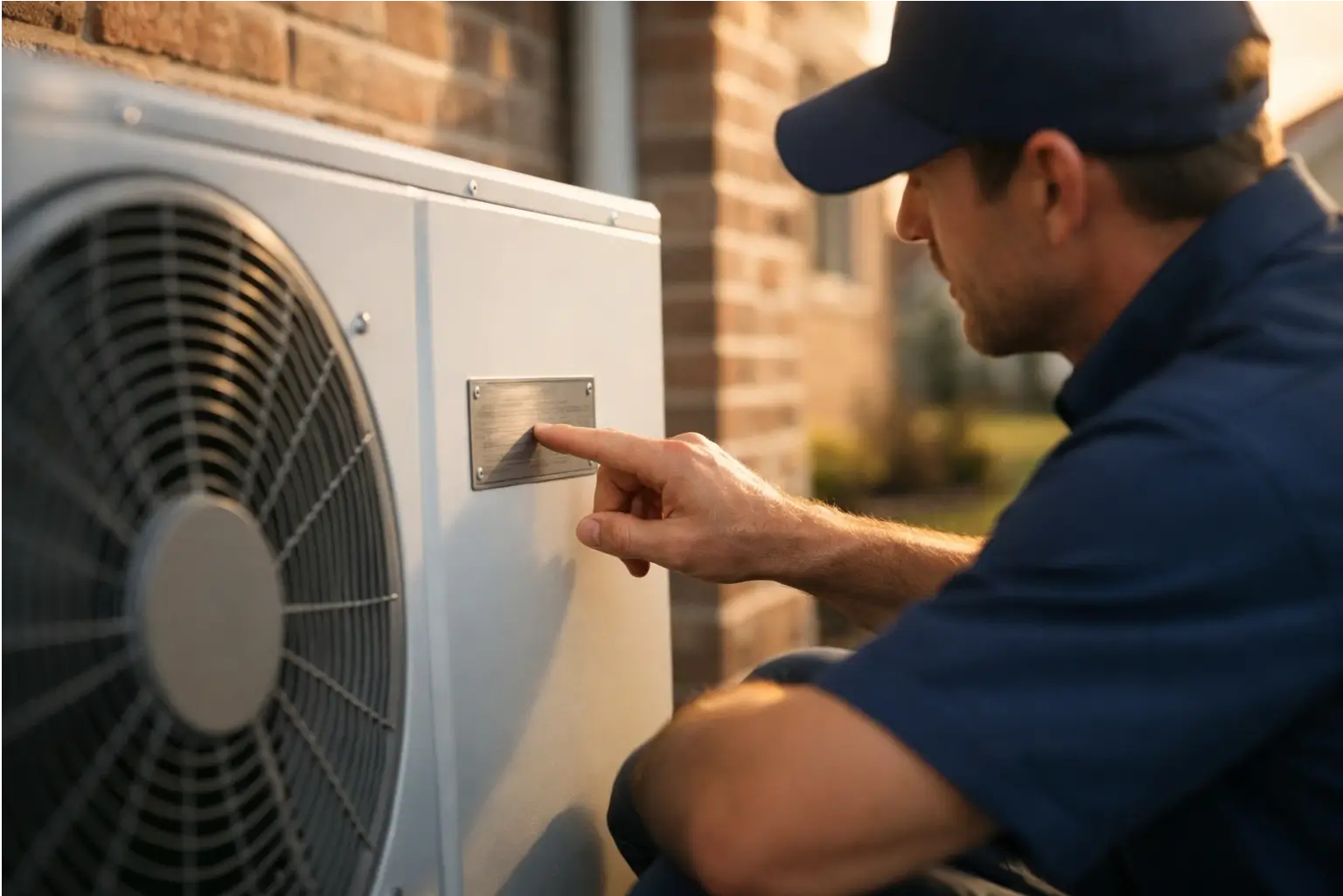
Your QMID appears on the outdoor unit’s nameplate sticker, on the manufacturer certification document provided at installation, or in the AHRI certificate your installer can pull for the system. If you can’t find it, contact your contractor directly – they should have it on file.
Pro Tip Get your QMID from your contractor at installation – not at tax filing time. Tracking down a 4-character code months after the job is done is harder than it sounds. Ask for the manufacturer certification document the day the equipment goes in.
The AHRI certificate – from the Air-Conditioning, Heating, and Refrigeration Institute – often contains both the model number and the QMID. Your HVAC contractor can typically generate or locate this within a day. If the manufacturer’s website has a product certification tool, that’s another route.
For windows and doors, the NFRC label (National Fenestration Rating Council) on the product usually contains model and certification data. Your window supplier or installer can direct you to the specific certification documentation for the products installed.
What Happens If Your QMID Is Missing?
If you leave the QMID field blank for a line that requires it, the IRS denies the credit for that specific item. The rest of your Form 5695 isn’t affected – but any line with a missing QMID is treated as ineligible, and you lose that portion of the credit entirely.
This is not a soft warning. The IRS will process your return without that credit. You’d need to file an amended return to correct it – which adds time and complexity to your filing. Getting the QMID before you file is far easier than amending afterward.
If you genuinely cannot locate the QMID and the manufacturer is no longer accessible, consult a tax professional. The IRS qualified manufacturer list is public, and a CPA or enrolled agent can help you verify whether an alternative source of documentation is acceptable.
Form 5695 Credit Limits – The Full Annual Cap System
Part I has no overall dollar cap. Part II has a structured two-bucket limit system that catches many filers off guard. Understanding exactly how those buckets work – and what fits where – determines how much of your credit you actually get to keep.
Part I – No Annual Dollar Cap for Clean Energy
For the residential clean energy credit under Part I, the 30% credit rate applies to your total eligible costs with no annual maximum – except for one item. Fuel cells carry a separate limit of $500 per 0.5 kilowatt of capacity.
If you spent $40,000 on a solar PV system in 2025, your potential credit is $12,000. There’s no cap that cuts that down. Your actual usable credit in a single year is limited only by your tax liability – but unlike Part II, any excess rolls forward to future years via Form 5695 line 16.
Labor costs are included in your eligible cost basis for Part I. Installation, wiring, and connection fees all count. That’s a meaningful difference from Part II, where labor rules are more restrictive.
Part II – The Two-Bucket Limit System
Part II uses a two-bucket structure. Bucket 1 covers most home improvement items with a combined $1,200 annual limit. Bucket 2 covers heat pumps and biomass equipment with a separate $2,000 annual limit. The maximum combined credit from both buckets in a single year is $3,200.
These are annual limits – they reset every tax year. That matters for planning. If you spread improvements across multiple years, you can potentially claim more total credit than if you bunch everything into one year.
Bucket 1 – $1,200 General Items (Sub-Limit Table)
Within the $1,200 Bucket 1 cap, individual item categories have their own sub-limits. Hitting the sub-limit for one item doesn’t affect the sub-limits for others – but all Bucket 1 items count toward the overall $1,200 annual ceiling.
| Item | Form 5695 Line | Sub-Limit | Notes |
|---|---|---|---|
| Insulation and air sealing | Line 18 | Part of $1,200 cap (no separate sub-limit) | No QMID required |
| Exterior doors (per door) | Line 19 | $250 per door / $500 total | QMID required |
| Exterior windows and skylights | Line 20 | $600 maximum | QMID required; Energy Star required |
| Home energy audit | Line 26 | $150 maximum | No QMID required; auditor must be certified |
| Central air conditioners | Line 22 | $600 maximum (shared with water heaters) | QMID required |
| Gas/oil/propane water heaters and furnaces | Lines 23 / 24 | $600 maximum (combined with AC) | QMID required |
| Electrical panel upgrade (enabling property) | Line 25 | $600 maximum | QMID required; only if it enables qualifying property |
To be clear: the $1,200 is the ceiling for all Bucket 1 items combined. If you spend $800 on windows and $500 on a new furnace in the same year, 30% of $800 is $240 and 30% of $500 is $150 – a total of $390, well under the $1,200 cap. But if your eligible costs were high enough to push the calculated 30% above $1,200, the credit stops at $1,200.
Bucket 2 – $2,000 Heat Pump and Biomass Limit
Bucket 2 has a $2,000 combined annual limit covering electric heat pumps, heat pump water heaters, and biomass stoves or boilers. This $2,000 applies to the category total – not per unit. If you install a heat pump and a biomass boiler in the same year, they share the $2,000 ceiling.
Heat pumps must meet the CEE (Consortium for Energy Efficiency) Tier 1 standard or better. Biomass equipment must operate at 75% thermal efficiency or higher. Your installer can confirm which tier or efficiency rating your specific equipment meets.
The Labor Cost Rule – When It’s Included vs. Excluded
Under Part II, labor costs for installing mechanical systems – heat pumps, water heaters, furnaces, and AC units – are included in your eligible cost basis. Labor costs for building envelope items – insulation, windows, and doors – are excluded. Only the cost of the materials themselves counts for those envelope items.
This distinction trips up a lot of filers, and even some contractors get it wrong. If your invoice bundles the heat pump equipment and installation labor into a single line item, that total goes into your eligible cost calculation. But if you’re claiming new double-pane windows, you need to separate the material cost from the installation charge on your invoice before calculating the 30% credit rate.
Keep itemized invoices showing a clear separation between materials and labor for any envelope improvements. If your contractor gave you a combined quote, ask for a breakdown before you file.
Carryforward Rules – What Rolls Over and What Doesn’t
This is where the most expensive filing errors happen. Part I and Part II handle unused credits in completely opposite ways – and assuming they work the same can cost you hundreds or thousands of dollars.
Part I Carryforward – How Unused Solar Credits Roll Forward
If your Part I residential clean energy credit exceeds your tax liability for the year, the unused amount carries forward to the next tax year. You report the carryforward amount on Form 5695 line 16, and it rolls to future returns until you’ve used it up. There is no time limit on how many years it can carry forward.
The carryforward applies even though both credits expired on December 31, 2025 under the One Big Beautiful Bill Act (OBBBA). The expiration affects new installations – it doesn’t eliminate a credit you legitimately earned in 2025 that exceeds your current year liability. That unused amount still carries forward to 2026 and beyond.
Worked Example 1 – Part I Carryforward
Sarah installed a $30,000 solar PV system in 2025. Her 30% credit is $9,000. Her 2025 federal tax liability is $5,500. She applies $5,500 of the credit against her liability (reducing it to $0), and the remaining $3,500 carries forward to her 2026 return via Form 5695 line 16. She owes nothing this year, and $3,500 waits for next year.
To use a carryforward credit in a future year, you still need to file Form 5695 in that year and enter the prior-year carryforward amount on the applicable line. Keep a copy of each year’s Form 5695 so you have a clear record of what carried forward and from which year.
Part II – No Carryforward – Unused Credits Are Permanently Lost
Critical Warning – Part II Has No Carryforward If your Part II energy efficient home improvement credit exceeds your tax liability, the excess is permanently lost. It does not roll forward to any future year – under any circumstance. This is confirmed in IRS Fact Sheet FS-2025-01.
Part II has no carryforward provision. If your calculated credit for home improvement items exceeds your tax liability for the year, the difference disappears. You cannot claim it in 2026 or any subsequent year. The IRS is explicit about this in IRS Fact Sheet FS-2025-01, and there are no exceptions.
This is the sharpest difference between the two parts of Form 5695. A filer with low tax liability in a given year can lose their entire Part II credit with no recourse. Knowing this in advance lets you plan more effectively – for example, by timing upgrades across years to match your expected liability.
Worked Example 2 – Part II No-Carryforward Consequence
David installed a qualifying heat pump in 2025. His eligible costs came to $8,000, giving him a 30% credit of $2,000 (at the Bucket 2 cap). His 2025 tax liability is only $900. He can apply $900 of the credit, reducing his liability to $0. The remaining $1,100 is permanently lost. It will not appear on his 2026 return.
Side-by-Side Carryforward Comparison
| Feature | Part I – Clean Energy Credit | Part II – Home Improvement Credit |
|---|---|---|
| Carryforward allowed? | Yes | No |
| What happens if credit > liability? | Excess carries to next year | Excess is permanently lost |
| Where is carryforward reported? | Form 5695, Line 16 | Not applicable |
| Time limit on carryforward? | None | Not applicable |
| Effect of OBBBA expiration on carryforward? | None – earned carryforward continues | Not applicable |
| IRS source | IRC Section 25D(c)(2) | IRS FS-2025-01 |
Strategies If Your Tax Liability Is Too Low
If you’re claiming Part II credits but your tax liability is modest, there are legitimate strategies to consider with a qualified advisor. These aren’t loopholes – they’re planning tools that work within the tax code as written.
The annual limit resets each year. So if you’re planning multiple improvements – new windows, a heat pump, and insulation – spreading them across multiple years is smarter than bundling them into one year where you can only absorb so much credit.
A Roth IRA conversion in the same year as Part I improvements can increase your tax liability, giving the credit more room to offset. Your converted amount adds to taxable income, raising liability – and your clean energy carryforward credits absorb that extra liability. Talk to a CPA before doing this; the interaction with other deductions requires careful modelling.
Deferring itemised deductions to a future year is another approach. If you plan to make a large charitable contribution, pushing it to 2026 instead of 2025 keeps your 2025 liability higher, leaving more room for the credit to land. Part II credits don’t carry forward – so front-loading your liability in the year of the improvement is the goal.
If you’re a lower-income household, HEEHRA – the High-Efficiency Electric Home Rebate Act – offers point-of-sale rebates through state programs that don’t depend on your tax liability at all. You can explore HEEHRA rebate programs by state as a parallel route to funding efficiency upgrades.
Commonly Missed Fields and Filing Mistakes
Beyond the QMID and carryforward rules, Form 5695 has several fields that either go unnoticed or get completed incorrectly. These are the ones that show up most often in amended returns and IRS correspondence.
The Nonrefundable Trap – What It Actually Means
Both Form 5695 credits are nonrefundable. That means they can reduce your tax liability to zero, but they can’t create a refund on their own. If you had $3,000 in withholding and your liability is $1,000, you’d normally get a $2,000 refund. A nonrefundable credit reduces the $1,000 liability to $0 – your refund becomes $3,000. The credit didn’t get paid to you; it eliminated what you owed.
Worked Example 3 – Nonrefundable Credit Explained
Laura has $5,000 withheld from her salary in 2025. Her actual tax liability is $4,200. Without the credit, she’d get an $800 refund. She claims a $1,500 Part II credit. That reduces her liability from $4,200 to $2,700. Now her refund is $2,300 ($5,000 minus $2,700). She did not “receive” $1,500 – she reduced what she owed. The $2,300 refund is still entirely from her withholding.
The confusion usually comes from the phrase “nonrefundable.” People interpret it as “the credit doesn’t give you any money back.” That’s wrong. Your withholding refund is completely separate. Nonrefundable simply means the credit itself can’t drive your return below zero. Understand that distinction and the form becomes far less intimidating.
Enabling Property – The 2025 Panelboard Rule
An electrical panel upgrade – also called a panelboard – qualifies as enabling property under line 25 only if it’s installed to enable another qualifying energy property in the same tax year, or meets the consecutive-year safe harbor. The panelboard upgrade alone doesn’t qualify. It must be directly connected to an eligible improvement.
The consecutive-year safe harbor means: if you install the panel upgrade in year one and the qualifying energy property in year two (the immediately following tax year), the panel upgrade can still count as enabling property. But it must be the very next year – the connection can’t span multiple years.
For example: if you upgraded your electrical panel in 2024 specifically to accommodate a heat pump you then installed in 2025, the panel upgrade may qualify as enabling property on your 2025 return. The panel’s cost (up to the $600 sub-limit under Bucket 1) can be claimed alongside the heat pump. Document the connection clearly – your contractor’s invoice and project notes should describe the relationship between the two installations.
Joint Occupancy – Unmarried Co-Owners
If two unmarried people co-own a home and both want to claim Form 5695 credits, each person files their own separate Form 5695 for their proportional share of the qualifying costs. You check the box on line 32a to indicate joint occupancy, and you must attach an allocation statement to your paper return showing how the costs are divided.
This is important: joint occupancy filers cannot e-file if they need to attach the allocation statement. The IRS e-file system doesn’t currently support that attachment. You’d need to paper-file that return. If you forget the statement or try to e-file without it, expect delays or rejection. Married couples filing jointly don’t face this issue – they file one return and one Form 5695 together.
Condominium and Cooperative Owners – Line 32b (New in 2025)
Line 32b is a new checkbox added for the 2025 tax year. It applies to condominium unit owners and cooperative housing shareholders who are claiming a fractional share of qualifying improvements made to the overall building. You enter your ownership percentage, and the eligible credit is calculated on your share of the total improvement costs.
If the condo association installed a qualifying heat pump system for the building and you own 8% of the building, you can claim 8% of the eligible cost as your basis for the credit. Line 32b is where you indicate this situation. Consult the association’s documentation to confirm your ownership percentage and the total cost of the qualifying work.
The Subsidy Deduction Requirement
If you received a utility rebate or a public utility subsidy to help fund a qualifying improvement, you must subtract that subsidy from your cost basis before calculating the credit. You can’t claim the 30% credit on money the utility effectively gave you. The IRS requires you to reduce your eligible costs by the subsidy amount first.
For example: if a heat pump cost $10,000 and your utility provided a $2,000 rebate, your eligible cost is $8,000 – not $10,000. Your 30% credit calculates from $8,000, giving you $2,400 rather than $3,000. State rebate programs and HEEHRA rebates interact with this rule differently; a tax professional can confirm the exact treatment for your situation.
What Qualifies in 2026 – Full Eligible Property Lists
Both credits have specific qualifying standards. Meeting the general category isn’t enough – the equipment must meet defined efficiency thresholds. Here’s what counts and what doesn’t.
Part I – Clean Energy Qualifying Property
Under the residential clean energy credit, qualifying property includes: solar photovoltaic (PV) panels, solar water heating equipment certified by the Solar Rating and Certification Corporation (SRCC), battery storage systems with a capacity of at least 3 kilowatt-hours, small wind energy property, geothermal heat pump property that meets Energy Star requirements, and qualified fuel cell property.
The 30% credit rate applies to the full cost of the system including installation labor, connecting hardware, and wiring directly associated with the property. For solar water heating systems, the SRCC certification is a hard requirement – a system without it doesn’t qualify regardless of its efficiency rating.
For a full breakdown of what counts under Part I, see our Residential Clean Energy Credit guide for solar and clean energy systems.
Part II – Home Improvement Qualifying Property
Under the energy efficient home improvement credit, qualifying property includes: insulation and air sealing materials that meet the 2021 International Energy Conservation Code (IECC) standard, exterior windows and skylights that carry the Energy Star Most Efficient certification, exterior doors that meet Energy Star requirements, heat pumps and heat pump water heaters that meet CEE Tier 1 or better, biomass stoves and boilers operating at 75% or higher thermal efficiency, and qualifying electrical panel upgrades that serve as enabling property.
Efficiency standards matter at the product level. Not every heat pump or every Energy Star window qualifies – the specific tier or certification level determines eligibility. Your installer should be able to confirm the qualifying standard for the exact model installed. If they can’t, ask for the product’s specification sheet and check it against the IRS eligibility criteria in the official Form 5695 instructions.
For heat pump-specific requirements, see our heat pump tax credit requirements guide. For audits, see our qualifying home energy audit guide.
What Doesn’t Qualify – Common Misconceptions
Electric vehicles do not qualify under Form 5695. EV credits go on Form 8936 for electric vehicle credits – a completely separate form with its own rules and limits. Appliances like refrigerators, washing machines, and dishwashers don’t qualify for either credit on Form 5695. General home renovations – new flooring, roof replacements not tied to solar installation, landscaping – don’t qualify either.
New construction is excluded from Part II. The energy efficient home improvement credit applies only to existing homes, not homes being built. Rental properties are generally excluded from Part II. Pure investment properties don’t qualify for Part I either – though a home used partly as a rental may qualify for Part I on a proportional basis depending on circumstances.
Pools and hot tubs do not qualify under any category on Form 5695, even if they use solar heating technology. The IRS is specific about this exclusion.
How to Fill Out Form 5695 – Line-by-Line Guide
This section walks you through the actual filing process. Have your documents ready before you start – jumping back to find a QMID mid-way through creates mistakes.
Documents to Gather Before You Start
- Itemized invoices for every qualifying improvement – materials and labor listed separately for envelope items
- QMID for each piece of specified property (doors, windows, AC, water heater, furnace, heat pump, panelboard)
- Manufacturer certification documents and AHRI certificates for mechanical systems
- SRCC certification for solar water heating equipment
- Your prior-year Form 5695 if you have a Part I carryforward amount from a previous year
- Your Form 1040 line 18 (your regular tax figure) – needed for the Part I credit calculation worksheet
- Any utility rebate or subsidy documentation so you can reduce your cost basis correctly
Part I Filing – Lines 1-16
Lines 1 through 14 collect your eligible costs for each category of clean energy property. Line 1 is for solar PV panels. Line 5b is for battery storage with a minimum 3 kWh capacity. Lines 2 through 7 cover the remaining categories – solar water heating, wind, geothermal, and fuel cells.
Lines 6a and 7b handle fuel cell property separately because the $500-per-0.5kW sub-limit applies there. Enter your total eligible cost on line 6a and the form calculates the capped amount. Add all lines through line 13 to get your total clean energy property costs.
Line 14 directs you to the Credit Limit Worksheet to check your credit against your tax liability. Line 15 is your actual Part I credit for the current year. Line 16 is your carryforward amount – this is what moves to next year’s Form 5695 if your credit exceeds your liability. Transfer the line 15 amount to Schedule 3, line 5a on your Form 1040. For a step-by-step guide, see our guide to completing Schedule 3 (Form 1040).
Part II Section A – Building Envelope (Lines 17-20)
Line 17 is a checkbox confirming the improvement was made to an existing home used as your principal residence. Check it before proceeding. Line 18 covers insulation and air sealing – no QMID needed here. Enter your material costs only; labor doesn’t count for this line.
Line 19 covers exterior doors. You enter the QMID for each door and the cost. The $250 per door and $500 total sub-limit applies here. Line 20a covers windows and skylights – QMID required, Energy Star Most Efficient certification required, $600 sub-limit. Line 20b is a checkbox to confirm the window or skylight meets the applicable Energy Star standard for your climate zone.
Part II Section B – Energy Property (Lines 21-32)
Lines 22, 23, and 24 cover central air conditioners, gas or oil water heaters, and gas or oil furnaces respectively. Each requires a QMID. These are all Bucket 1 items sharing the $600 sub-limit with the panelboard. Enter your eligible costs (including installation labor for these mechanical systems) and the QMID for each.
Line 25 is for enabling property – the panelboard upgrade. Enter the QMID and eligible costs. The $600 sub-limit applies. You can only complete this line if the panelboard qualifies as enabling property (tied to another qualifying improvement in the same or immediately prior tax year). Line 26 is the home energy audit – no QMID needed, $150 maximum. Your auditor must hold a valid BPI or RESNET certification.
Lines 29 and 30 are Bucket 2. Line 29a covers electric heat pumps and heat pump water heaters – QMID required. Line 30a covers biomass stoves and boilers. The $2,000 Bucket 2 cap applies to the total of lines 29 and 30 combined. Line 32 carries the checkboxes: 32a for joint occupancy, 32b for condo or co-op owners claiming a fractional share.
Transferring Credits to Your Tax Return
Part I credit (Form 5695 line 15) goes to Schedule 3, line 5a. Part II credit (Form 5695 line 30) goes to Schedule 3, line 5b. Both Schedule 3 amounts flow to Form 1040 line 20, which reduces your total tax. Attach your completed Form 5695 to your return. If you’re paper-filing due to joint occupancy, include the allocation statement as a separate attachment.

Credit Expiration – What 2026 Filers Need to Know
Both credits expired at the end of 2025. But filing your 2025 return in 2026 is not the same as claiming credits for 2026 installations. Here’s exactly what you can and can’t still claim.
What the OBBBA Changed
The One Big Beautiful Bill Act (OBBBA), signed into law as Public Law 119-21, terminated both the Section 25C energy efficient home improvement credit and the Section 25D residential clean energy credit for property placed in service after December 31, 2025. This is confirmed in IRS Fact Sheet FS-2025-05.
Prior to the OBBBA, both credits were scheduled to run through 2032 under the Inflation Reduction Act. The OBBBA changed that. Any article or resource that still states 2032 as the end date is using outdated information. The cut-off for new qualifying installations is December 31, 2025.
The One Big Beautiful Bill Act’s impact is clear for new purchases: if you install a heat pump or solar panels in 2026 or later, those costs don’t qualify under Form 5695 under current law. For a full picture of what applied to 2025, see our 2025 residential energy credits overview.
What You Can Still Claim Filing Your 2025 Return in 2026
Filing in 2026 for your 2025 tax year is completely normal – most people file between January and April 2026 for the 2025 tax year. If you had qualifying property placed in service at any point during 2025, you claim the credit on your 2025 return using Form 5695. The expiration date affects new installations, not your entitlement to credit already earned.
For Part I carryforward amounts: if you carry forward unused clean energy credits from 2025 to 2026, those credits still apply against your 2026 tax liability even though new installations in 2026 don’t qualify. The carryforward is based on when the credit was earned – 2025 – not when it’s applied. Keep your Form 5695 line 16 documentation current and accurate.
Frequently Asked Questions
What is a QMID on Form 5695?
A QMID – Qualified Manufacturer Identification Number – is a 4-character alphanumeric code assigned to a manufacturer registered with the IRS under Revenue Procedure 2024-31. The IRS requires it for most specified energy property claimed under Part II. If your equipment doesn’t have a valid QMID, the credit for that line is denied. Find it on the equipment nameplate or manufacturer certification document.
Can I carry forward unused Form 5695 credits?
It depends on which part. Part I – the residential clean energy credit for solar and similar systems – allows unused credit to carry forward indefinitely to future tax years via Form 5695 line 16. Part II – the energy efficient home improvement credit – does not allow a carryforward under any circumstance. Unused Part II credit is permanently lost at the end of the tax year.
What is the Form 5695 maximum credit for 2025?
Part I has no annual dollar cap – your credit is 30% of all eligible clean energy costs with no ceiling (except $500 per 0.5 kW for fuel cells). Part II has a $1,200 annual limit for general improvement items in Bucket 1, and a separate $2,000 annual limit for heat pumps and biomass equipment in Bucket 2. The combined Part II maximum is $3,200 per year.
Does Form 5695 have an income limit?
No. Neither the Part I residential clean energy credit nor the Part II energy efficient home improvement credit has an income limit. Any taxpayer who installed qualifying property at an eligible home can claim the credit regardless of income. The only financial constraint is your tax liability for the year, which determines how much of the credit you can actually use.
Where do I find my QMID for Form 5695?
Your QMID appears on the outdoor unit nameplate, the manufacturer certification document provided at installation, or the AHRI certificate your contractor can pull for the system. For windows and doors, check the NFRC label or ask your supplier. Insulation, air sealing materials, and home energy audits don’t require a QMID at all. Ask your installer before the job is done – it’s much easier than tracking it down later.
What is the difference between Part I and Part II of Form 5695?
Part I covers the residential clean energy credit for solar panels, battery storage, wind, geothermal, and fuel cells. It has no annual dollar cap and allows carryforward of unused credits. Part II covers the energy efficient home improvement credit for upgrades like heat pumps, insulation, windows, and doors. It has strict annual caps ($3,200 maximum combined) and no carryforward – unused credit is lost at year end.
Is Form 5695 still available in 2026?
Yes – for 2025 tax year returns filed in 2026. If you installed qualifying property during 2025, you file Form 5695 with your 2025 tax return, which is filed in 2026. Both credits expired December 31, 2025 for new installations under the One Big Beautiful Bill Act (OBBBA), so property placed in service in 2026 does not qualify. But your 2025 installations are fully eligible.
What does nonrefundable mean on Form 5695?
Nonrefundable means the credit reduces your tax liability to zero but can’t generate a refund beyond what you had from withholding. If your employer withheld $5,000 and your actual liability is $3,000, you’d normally get $2,000 back. A $3,000 nonrefundable credit wipes out your liability, making your refund $5,000 – but that refund comes from your withholding, not from the credit itself.
Can I claim Form 5695 without itemizing deductions?
Yes. These are tax credits, not deductions. You claim them via Form 5695 regardless of whether you take the standard deduction or itemize. Credits directly reduce your tax liability after deductions have already been applied. You don’t need to itemize, you don’t need Schedule A, and choosing the standard deduction has no effect on your ability to claim residential energy credits.
What happens if my credit exceeds my tax liability?
For Part I, the excess carries forward to the next tax year via Form 5695 line 16. You can use it in future years until it’s fully applied, with no time limit. For Part II, the excess is permanently lost – there is no carryforward mechanism under any circumstance, confirmed in IRS Fact Sheet FS-2025-01. This is why planning Part II claims around your expected tax liability matters so much.
Can I claim the credit for a rental property?
Generally no for Part II – the energy efficient home improvement credit applies only to your principal residence. Part I has more flexibility: the residential clean energy credit can apply to your main home or a secondary U.S. residence. A pure investment or rental property doesn’t qualify for either credit. A home that’s partly a rental may qualify for Part I on a proportional basis; consult a tax professional for the correct allocation method.
What is the enabling property rule on Form 5695?
An electrical panelboard upgrade qualifies as enabling property – and is eligible for a credit of up to $600 under line 25 – only if it’s installed to enable another qualifying energy property. That qualifying property must be installed in the same tax year, or in the immediately following tax year under the consecutive-year safe harbor. A standalone panel upgrade with no connection to a qualifying improvement does not qualify on its own.
What is Form 5695 line 32b?
Line 32b is a new checkbox added for the 2025 tax year. It applies to condominium unit owners and cooperative housing shareholders claiming a fractional share of qualifying improvements made to the overall building. You enter your ownership percentage, and the credit calculates on your proportional share of the eligible improvement costs. This field was previously absent from the form and is specific to the 2025 version.
Do I need a QMID for insulation?
No. Insulation and air sealing materials claimed on Form 5695 line 18 are exempt from the QMID requirement. Home energy audits claimed on line 26 are also exempt. All other specified energy property under Part II – including doors, windows, air conditioners, water heaters, furnaces, heat pumps, and panelboards – does require a valid QMID. Insulation and audits are the two explicit exceptions.
Can two unmarried homeowners both claim Form 5695?
Yes. Each unmarried co-owner files a separate Form 5695 for their proportional share of qualifying costs. Each must check the joint occupancy box on line 32a and attach an allocation statement showing how costs are divided. Because the allocation statement can’t be submitted electronically, joint occupancy filers using this checkbox must paper-file their return. Married couples filing jointly have no such restriction – they share one Form 5695.






[…] 25C previously allowed homeowners to claim panel upgrades at 30% (up to a $1,200 cap) as standalone home improvements. The Section 25C panel upgrade expiration came on December 31, 2025. Under 48E, the opportunity […]
[…] here’s the part people miss: you don’t have to “pick a side” to benefit. If you’re a developer, a startup, or an […]
[…] federal tax code. You don’t need to itemize your deductions to claim it. Just file IRS Form 5695 – the Residential Energy Credits form – with your regular federal tax return. But honestly, the $150 is the least interesting […]
[…] here is the bit many people miss. In the UK, estate agents are legally expected to pass offers on to the seller, even if the offer […]
[…] Pennsylvania. She trained at New York University’s Experimental Theatre Wing, which helps explain the stage control and precision people often notice in her […]
[…] that confuses almost everyone. And fair enough. The pipework terms sound like something invented by people who enjoy forms far too […]