




The Receipts You Must Keep (and for How Long)
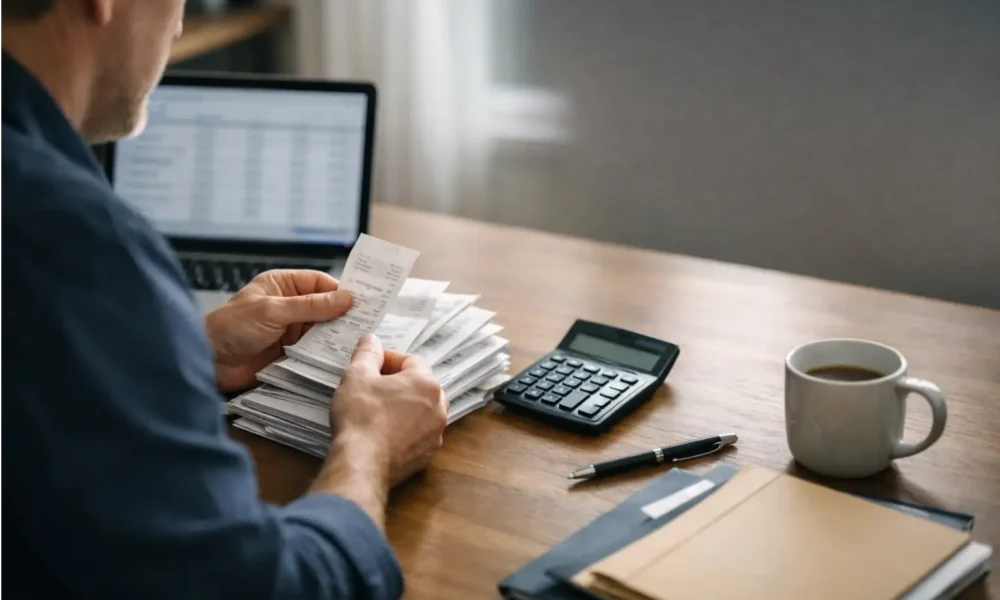
Most people don’t think about their business receipts until HMRC sends a letter. By then, sorting through a pile of faded paper, or admitting you threw most of them away, stops being an option. If you’re self-employed, run a limited company, or claim work expenses as an employee, knowing which receipts you must keep, and for how long, isn’t a nice-to-have. It’s a legal requirement under UK tax law.
In this guide, we cover exactly what HMRC expects, broken down by business type, with straightforward rules on retention periods, storage options, and what to do when records go missing. No jargon. No guesswork. Just clear, practical information you can actually use.
Why You Are Legally Required to Keep Receipts in the UK
Keeping business records isn’t just good practice. Under UK tax law, HM Revenue and Customs (HMRC) requires every business and self-employed individual to maintain financial records that support their tax return. HMRC has the legal right to inspect those records at any time.
Without proper business receipts, you can’t prove the figures on your tax return are correct. Every claim you make, from office supplies to travel costs, needs proof of purchase behind it. If you can’t provide that proof during a tax investigation, HMRC can disallow the expense and charge additional tax, plus interest.
Accurate bookkeeping records also protect you in the event of an HMRC audit. The stronger your records, the shorter and less disruptive the process.
What Counts as a Business Receipt?
A business receipt is any document that proves a transaction took place. This includes physical paper receipts, digital receipts, supplier invoices, bank statements, till rolls, and email order confirmations. As long as the record shows the date, amount, supplier, and nature of the purchase, HMRC accepts it as valid proof of purchase.
It’s worth knowing that a bank statement alone may not always be enough. It shows money left your account, but it doesn’t explain what was bought or why it was a business expense. Where possible, keep the original invoice or receipt alongside your bank statement as backup.
What Happens If You Don’t Keep Records?
If you fail to maintain adequate business records, HMRC can charge a penalty of up to £3,000 for careless or inaccurate records. Beyond that fine, inspectors can disallow your expense claims entirely, assess additional tax on the disallowed amounts, and add interest charges on any unpaid tax going back years.
The risks go further than a fine. An HMRC audit triggered by missing records can be lengthy, stressful, and expensive, especially if you need professional help to deal with it. Keeping clear bookkeeping records from the start is far cheaper than fixing the problems afterwards.
Which Receipts Must You Keep? The Complete Checklist
Knowing you need to keep receipts is one thing. Knowing exactly which ones is another. The types of records HMRC expects you to hold depend on your business type and the expenses you’re claiming. Below is a breakdown by category.
Income and Sales Records
Every penny that comes into your business needs to be traceable. That means keeping invoices sent to clients, till rolls, sales records, and records from online payment platforms such as PayPal or Stripe. If you take cash payments, record each one with the date, amount, and a note of what it was for.
Good income records make your Self Assessment tax return quicker to complete and far easier to defend if HMRC questions your figures. Every entry on your tax return should have a corresponding sales record to back it up.
Business Expense Receipts
These are the receipts to keep for tax purposes that most sole traders and limited companies focus on. They cover office costs, professional fees, marketing and advertising, equipment purchases, and any cost directly related to running your business. Each receipt should show the date, supplier, amount, and what it was for.
Don’t overlook smaller purchases. A pattern of regular small expenses without receipts can raise flags during a compliance check just as easily as a large undocumented claim. Keep receipts for all allowable business expenses, regardless of size.
Mileage and Travel Records
HMRC doesn’t just want a fuel receipt, it wants a mileage log. That means recording the date, starting point, destination, business purpose, and miles travelled for every business journey. The HMRC approved mileage rate is 45p per mile for the first 10,000 business miles in a tax year, dropping to 25p per mile after that.
Without a proper mileage log, HMRC can reject your entire travel claim even if you genuinely made those journeys. A simple spreadsheet or a mileage tracking app covers this requirement with very little effort.
Home Office and Working From Home Receipts
If you work from home and claim a portion of your household costs as a business expense, you need supporting evidence. That includes utility bills, broadband statements, and rent or mortgage interest records. You’ll also need to document your business-to-personal use ratio clearly.
HMRC offers a simplified expenses option, a flat weekly rate based on hours worked from home, that removes the need for detailed household bills. If you use actual costs instead, keep every bill and record your working hours at home carefully to show your calculation is fair.
VAT Records (VAT-Registered Businesses Only)
VAT-registered businesses have extra record-keeping duties on top of standard business receipts. You must keep all VAT invoices, both issued and received, along with VAT returns, input tax records, and output tax records. Each VAT invoice must show the supplier’s VAT number, the rate applied, and the VAT amount charged.
VAT records must be kept for a minimum of 6 years, regardless of your business structure. If you use the VAT MOSS scheme, that period extends to 10 years. HMRC can inspect VAT records during a routine VAT audit or compliance check, so keep them organised and easy to find.
PAYE and Payroll Records (Employers)
If you employ staff, your PAYE records fall under their own retention rules. You must keep payslips, PAYE submissions, National Insurance contribution records, RTI (Real Time Information) returns, P60s, P45s, and statutory pay records such as sick pay or maternity pay.
PAYE records should be kept for at least 3 years from the end of the tax year they relate to, though many accountants recommend 6 years to cover any HMRC investigation risk. Good payroll records also protect both you and your employees if any pay disputes arise.
Property and Landlord Records
Landlords have a specific set of receipts to retain that other business types don’t. These include rental income records, mortgage interest statements, letting agent invoices, repair and maintenance receipts, buildings and contents insurance, ground rent, and council tax records for HMO properties.
Landlord tax records support your property income and expenditure claims on your Self Assessment return. They matter most if HMRC questions the level of allowable expenses you’ve offset against rental income. Keep records for every property you let, not just the busiest ones.
Employee Expense Receipts
Employed individuals can also claim tax relief on certain work costs that their employer doesn’t reimburse. To do this through a P87 form or Self Assessment return, you need to keep receipts for professional subscriptions, work tools and equipment, uniforms or specialist clothing, and travel costs for business trips. Commuting to a regular workplace doesn’t count.
Employee expense receipts don’t need to be complex documents. A confirmation email from a professional body for your subscription fee, or a till receipt from a supplier for tools used solely for work, is exactly what HMRC needs to process your claim.
How Long Must You Keep Your Business Receipts?
Rules by Business Type
This is the question that causes the most confusion. The answer depends on whether you’re a sole trader, a limited company, or something else entirely. Disposing of records too early is one of the most common reasons people run into difficulties during an HMRC investigation.
The Retention Period Table
Here’s a clear breakdown of how long to keep receipts in the UK by business type:
| Business Type | Minimum Retention Period |
|---|---|
| Sole Trader / Freelancer | 5 years after the 31 January deadline of the relevant tax year |
| Partnership | 5 years after the 31 January deadline of the relevant tax year |
| Limited Company / LLP | 6 years from the end of the company’s last financial year |
| VAT-Registered (any structure) | 6 years from the end of the VAT period |
| Employer (PAYE) | 3 years from the end of the tax year they relate to |
| CIS Contractor / Subcontractor | 5 years after the 31 January filing deadline |
When the Clock Actually Starts
Most people assume the 5-year or 6-year clock starts ticking on the date of the transaction. It doesn’t. For sole traders and partnerships, the financial records retention countdown begins on 31 January following the end of the relevant tax year, not the date the receipt was issued.
As a practical example, records for the 2023/24 tax year, filed by 31 January 2025, must be kept until at least 31 January 2030. Note that date when you file each year so you know exactly when it’s safe to clear out old records. Disposing of records too early, even unintentionally, can create serious problems if HMRC opens an enquiry.
Assets, Equipment and Long-Life Items
Standard retention rules don’t always apply to capital assets. If you’ve bought machinery, a vehicle, or equipment expected to last longer than the standard retention period, you should keep the purchase receipts for the full life of the asset, plus the standard retention period on top.
This matters for capital allowances claims, which are based on what you paid for the asset. Without the original proof of purchase, you can’t defend the value you’ve claimed. For business vehicles especially, keep every purchase receipt, service record, and insurance document for as long as you own the asset.
The 20-Year Rule
When HMRC Can Investigate Further Back
For standard tax enquiries, HMRC normally looks back up to 4 years. For careless errors, that window extends to 6 years. But if HMRC suspects deliberate tax fraud or tax avoidance, they can open an investigation going back up to 20 years.
This doesn’t mean every business must retain every receipt for two decades. It does mean that if you have a history of late filing, prior investigations, or complex tax affairs, disposing of records at the standard point carries more risk than it would for a straightforward, low-risk business. If you’re in any doubt, keep them. Digital storage is cheap. HMRC penalties are not.
How to Store Your Receipts
Digital, Paper, and Cloud Options
HMRC accepts both digital receipts and paper receipts as valid proof of purchase. You don’t need to keep both. However you store your records, they need to be legible, accessible, and retrievable if HMRC asks to see them during a compliance check.
Going Digital
HMRC’s Requirements for Electronic Records
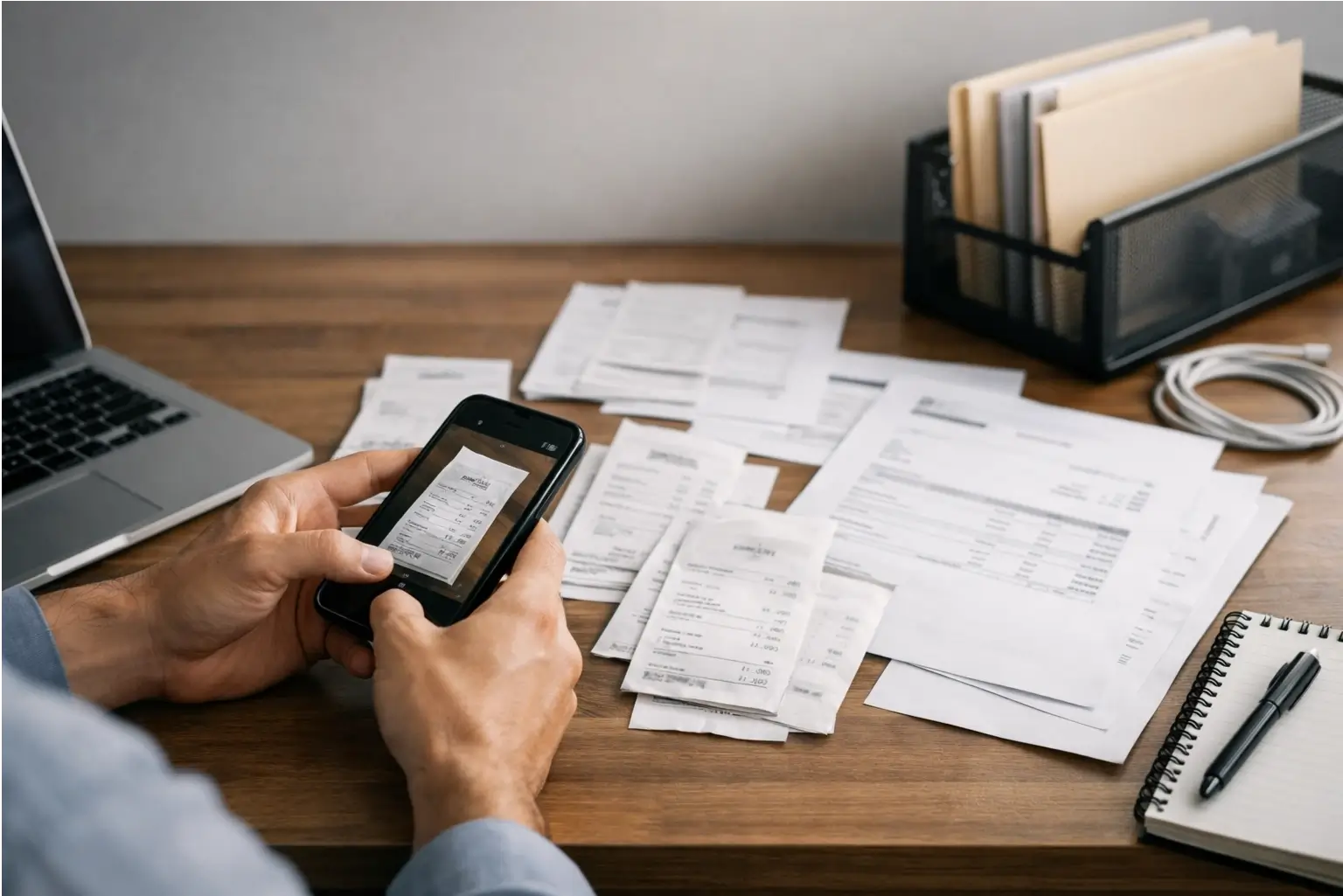
HMRC accepts scanned or photographed receipts as long as they’re clear and readable. Acceptable formats include PDF scans, JPG or PNG photos taken on your phone, and email order confirmations saved in a folder. You don’t need to hold on to the paper original once a clear digital version has been saved securely.
Making Tax Digital rules are also pushing businesses firmly toward electronic records. Under MTD ITSA, sole traders and landlords earning over £50,000 must use compatible software to store records and report to HMRC quarterly from April 2026. Starting with digital records now makes that transition far less disruptive.
Recommended Digital Filing Structure
A clear folder system makes tax time much less painful. We’d suggest structuring your files as: /Tax Year → /Month → /Category, where categories include Sales, Purchases, VAT, and PAYE. Consistent naming means you can locate any record in seconds rather than minutes.
Always store your records in at least two separate locations. Cloud services such as Google Drive, OneDrive, or Dropbox alongside a local copy on your computer or an external hard drive covers you if one system fails. Losing digital records and failing to recover them puts you in exactly the same position as someone who threw away their paper receipts.
Receipt Scanning Apps and Accounting Software
Several tools make receipt management easier day-to-day. Dext (formerly Receipt Bank) lets you photograph receipts and automatically extracts the key data. Accounting platforms such as Xero, QuickBooks, and FreeAgent connect directly to your bank feed and let you attach digital receipts to each transaction as it happens.
These tools don’t just save time, they create an organised, audit-ready record from the moment the expense occurs. Whether you use traditional accounting or cash basis accounting, good software handles the categorisation and stores everything in one searchable place.
Keeping Physical Paper Records
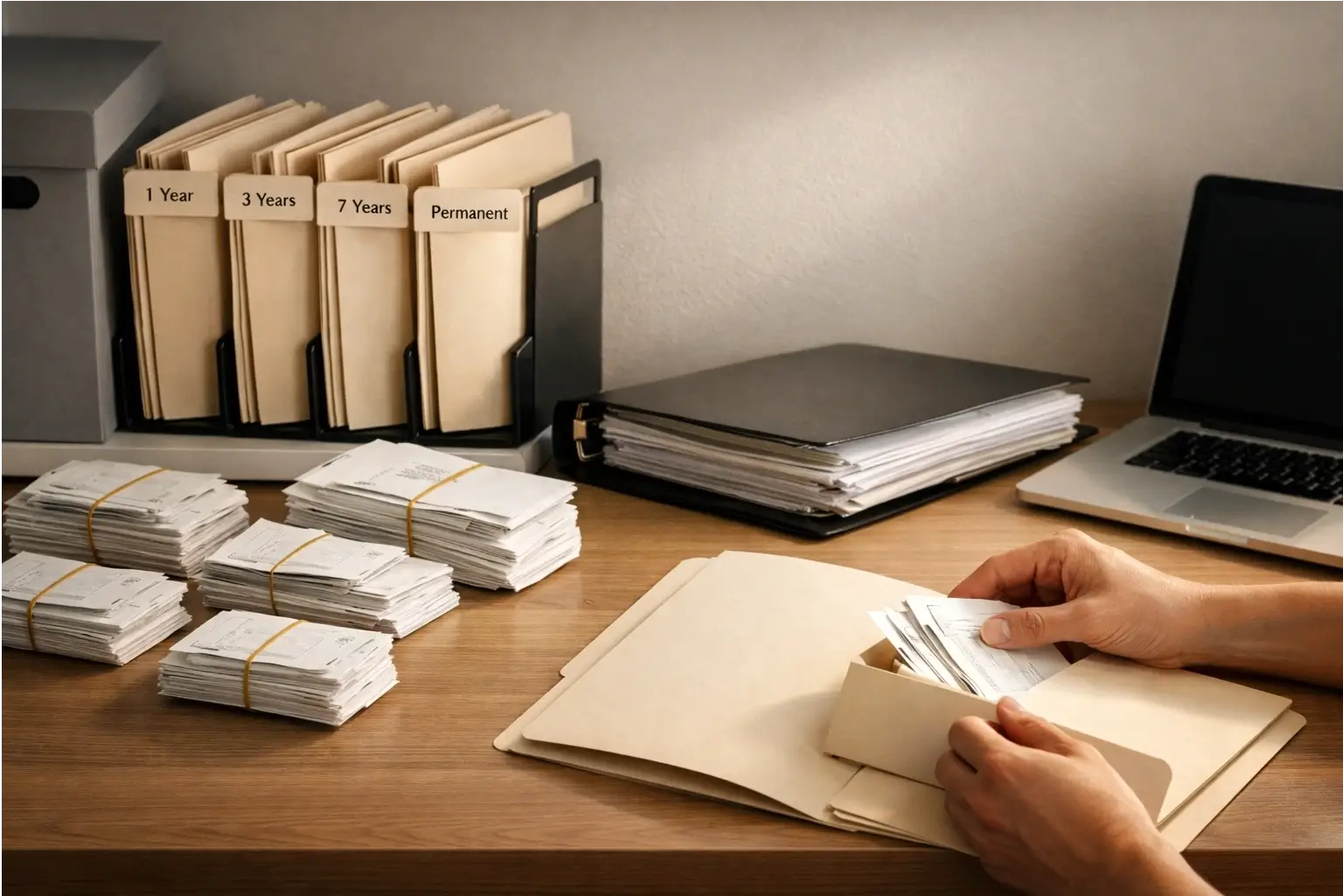
If you prefer to keep paper receipts in the UK, organisation is everything. Use labelled folders by month and category, stored somewhere dry, secure, and for your most critical documents, fireproof. One commonly overlooked problem: thermal paper receipts, the kind printed at most tills, fade badly over time, often within just a few years.
Scan thermal receipts as soon as you receive them. Don’t rely on the physical copy surviving the full 5 or 6-year retention period. A faded, illegible receipt proves nothing to an HMRC inspector.
What to Do If You’ve Lost Receipts or Records
Losing receipts happens. What matters is how you respond to it, and whether you address it before HMRC spots the gap. Trying to claim expenses without receipts or equivalent proof puts you in a weak position if your tax return is ever questioned.
Alternatives to Original Receipts HMRC Will Accept
Bank statements and credit card statements can substitute for an original receipt when the original is unavailable. They show the date and amount but not always the business purpose, so pair them with a brief written note explaining what the expense was for and why it was business-related. Supplier invoice copies can also be requested from the original seller in most cases.
Contractor quotes, delivery notes, and signed agreements can also support a claim when the original receipt is missing. For small, recurring expenses with a consistent spending pattern, a written estimate submitted with a clear explanation will often satisfy an inspector during a routine enquiry.
How to Inform HMRC About Missing Records
If you’re completing your Self Assessment return and know some records are missing, don’t estimate and say nothing. Explain any estimates clearly within the return itself, or include a covering note. An accountant can help you produce defensible estimates based on bank data, prior year returns, and industry averages.
Contacting HMRC proactively, before an investigation starts, almost always produces a better outcome than waiting for them to find the gap themselves. HMRC responds far more constructively to transparency than to unexplained figures or inconsistencies.
Making Tax Digital and the Future of Receipt Keeping
Making Tax Digital (MTD) is changing how UK businesses store and submit their financial records. MTD ITSA (Income Tax Self Assessment) requires sole traders and landlords earning over £50,000 to use approved software to submit quarterly updates to HMRC from April 2026. That threshold drops to £30,000 from April 2027, pulling more self-employed individuals and landlords into scope.
What MTD Means for Your Receipt-Keeping Habits
Under MTD ITSA, digital records won’t just be recommended, they’ll be mandatory for affected businesses. Receipts will need to be attached to transactions inside approved MTD-compatible software, not stored loosely in a folder and submitted once a year. A paper-only record-keeping system will no longer be compliant for sole traders and landlords within the scope of the rules.
If you currently use manual records or a basic spreadsheet, now is the time to look at MTD-compatible accounting software options. Businesses that prepare early will find the April 2026 deadline far less disruptive than those who leave it to the last minute. MTD ITSA record keeping starts with your receipts. Get that part right first.
Frequently Asked Questions
Do I need to keep receipts to claim business expenses?
No, you don’t submit receipts when filing your tax return, but HMRC may ask to see them during a tax investigation or compliance check. You must have receipts or equivalent proof available to support every expense claim you make. Without that evidence, HMRC can disallow the claim, assess additional tax, and charge penalties on top.
How long do I need to keep receipts as a sole trader in the UK?
As a sole trader, you must keep all business receipts and records for at least 5 years after the 31 January tax return deadline for the relevant year. For example, records for the 2023/24 tax year, filed by 31 January 2025, must be kept until at least 31 January 2030. The countdown starts from the filing deadline, not the transaction date.
How long must a limited company keep receipts?
Limited companies must retain their accounting records for at least 6 years from the end of the company’s last financial year they relate to. Records for assets expected to last longer, or for transactions that span multiple accounting periods, may need to be kept beyond that standard minimum.
Can I use bank statements instead of receipts?
Bank statements can act as supporting evidence when the original receipt isn’t available, but they may not satisfy HMRC on their own for all types of transaction. They show that money was spent but not what was purchased or the business purpose behind it. Always try to obtain a duplicate receipt or invoice from your supplier as a stronger substitute.
What happens if I don’t keep receipts and HMRC investigates me?
Failing to keep adequate records can result in HMRC disallowing expense claims, assessing additional tax owed, and charging penalties of up to £3,000 for careless or inaccurate records. Interest is added to any unpaid tax. In cases of deliberate non-compliance, penalties are far larger and HMRC may refer the matter for criminal investigation.
Do digital or scanned receipts count for HMRC?
Yes. HMRC accepts digital copies of receipts, including scanned images and phone photos, provided they’re clear and legible. You no longer need to keep the paper original once a secure digital version has been saved. Back up all digital files in at least two separate locations to protect against losing records entirely.
What receipts does an employee need to keep?
Employees claiming unreimbursed work expenses need to keep receipts for professional subscriptions, work tools or equipment, travel costs for genuine business trips, not commuting, uniforms or specialist clothing, and any other expenses claimed via a P87 form or Self Assessment return. Keep these records for at least 4 years from the end of the relevant tax year.
How far back can HMRC investigate my tax records?
For standard tax enquiries, HMRC normally looks back up to 4 years. For careless errors, that extends to 6 years. If HMRC suspects deliberate tax fraud or evasion, they can investigate records going back up to 20 years. Advisers often recommend keeping records indefinitely when tax affairs are complex or a prior investigation has taken place.
Do I have to keep receipts for expenses under £10?
There’s no official HMRC threshold below which receipts aren’t required, you should keep proof of all business expenses regardless of value. In practice, a bank statement showing small purchases may satisfy an inspector, but keeping all receipts remains the safest approach and costs nothing extra.
What records must a VAT-registered business keep?
VAT-registered businesses must keep all VAT invoices showing the supplier’s VAT number, the rate applied, and the amount charged, along with VAT returns, input and output tax records, and any adjustments made. VAT records must be kept for at least 6 years, or 10 years if you use the VAT MOSS scheme.








[…] The Receipts You Must Keep (and for How Long) […]
[…] II uses a two-bucket structure. Bucket 1 covers most home improvement items with a combined $1,200 annual limit. Bucket 2 covers heat pumps and biomass equipment with a […]