




Heat Pump Credit vs Rebate vs Utility Incentive: Don’t Stack Wrong (And Miss Thousands)
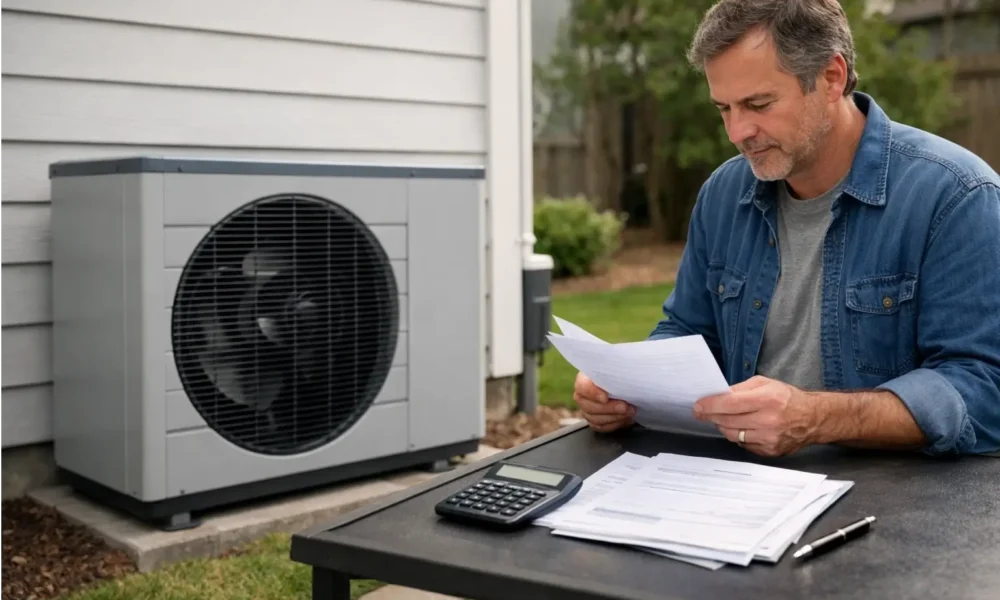
Installing a heat pump in 2025 can unlock real money – federal tax credits, IRA incentives, state rebates, and utility programmes all exist to help you cover the cost. But here’s the thing most people don’t know: combining them the wrong way can quietly reduce your federal heat pump tax credit without you realising it.
I’ve seen this happen more times than I’d like. A homeowner installs a qualifying air source heat pump, gets a manufacturer rebate, and then claims 30% of the original sticker price on their tax return. The IRS has rules that say certain rebates must be subtracted from your qualified cost before you calculate the Section 25C credit. When you miss that rule, you’re either leaving money on the table or overclaiming – neither of which is good.
This guide covers what each incentive type actually is, how the Inflation Reduction Act (IRA) changed the picture, and the specific IRS stacking rules you need to know before you file. Whether you’re weighing up a heat pump rebate against the 25C tax credit, trying to figure out utility incentive stacking, or just trying to get the maths right – you’re in the right place.
Quick answer – Can you stack a heat pump tax credit with a rebate? Yes, but rebates from the manufacturer or seller reduce your qualified cost basis, which lowers the amount your credit is calculated on. You can still benefit from both – you just need to apply them in the right order.
The Big Three: Federal Tax Credit, Rebate, and Utility Incentive – Defined
Before we talk about stacking rules, you need a solid picture of what each incentive actually is. These three things sound similar. They’re not. Mixing them up is exactly where mistakes start.
What Is the Federal Heat Pump Tax Credit (Section 25C)?
The federal heat pump tax credit – officially called the Energy Efficient Home Improvement Credit under Section 25C – gives you back 30% of your qualifying installation cost, up to a $2,000 maximum credit per year. It’s a nonrefundable credit, meaning it reduces your federal income tax bill directly, dollar for dollar. You must owe federal income taxes to benefit from it.
That distinction between a tax credit and a tax deduction matters here. A deduction reduces the income the government taxes you on. A credit reduces the actual tax bill you owe. So if you owe $1,500 in federal income tax and your 25C credit is worth $2,000, it wipes out your $1,500 bill – but the remaining $500 doesn’t come back to you as a refund. It’s gone.
The $2,000 maximum credit for heat pumps sits within a broader $3,200 annual cap across all qualifying 25C home improvements. There’s no lifetime cap, which means you can claim up to $2,000 in heat pump credits each tax year indefinitely – as long as the credit remains active. You claim it using IRS Form 5695 when you file your federal tax return.
Expiration notice: The 25C credit expired on December 31, 2025. If your heat pump was installed and placed in service during the 2025 tax year, you can still claim it on your 2025 return, filed in 2026. There is currently IRA extension uncertainty under the current administration – speak to a tax advisor for the latest position.
What Is a Heat Pump Rebate?
A heat pump rebate is money you receive either as an upfront discount at point of sale or as a direct payment after your installation is complete. Rebates don’t depend on your tax liability – you don’t need to owe federal income taxes to benefit. The main federal rebate option is the HEAR programme under the IRA, which offers up to $8,000 for low-income households.
The HEAR programme (Home Energy Rebates) is income-based and funded by the IRA. It’s delivered at the state level, which means availability depends on where you live. Manufacturer and retailer rebates are a separate category entirely – these come from the company that made or sold your heat pump and typically reduce your upfront purchase price.
The key point to hold onto is this: a rebate is money off your cost. It’s not a tax mechanism. But as I’ll cover in detail shortly, certain rebates directly affect the qualified cost your 25C credit is calculated on. That connection is what most homeowners miss.
What Is a Utility Incentive?
A utility incentive is a programme run by your electricity or gas company, completely separate from any federal or state programme. It can take the form of a cash rebate, a bill credit, or an equipment subsidy. The amount and structure vary widely depending on your location and which utility company you’re with.
Some utilities offer $300 to $800 back on a qualifying heat pump installation. Others give you bill credits spread over a billing period. A smaller number run utility heat pump programmes where the subsidy goes directly to your contractor rather than to you. That last arrangement has some specific IRS implications – more on that in the stacking section.
The DSIRE database at dsireusa.org is the most reliable place to search for utility heat pump programmes in your area. It covers all 50 states and the District of Columbia.
Side-by-Side Comparison Table
| Feature | Federal Tax Credit (25C) | Heat Pump Rebate (HEAR) | Utility Incentive |
|---|---|---|---|
| Source | IRS / Federal | Dept. of Energy via state | Local utility company |
| Maximum Amount | 30%, up to $2,000 | Up to $8,000 (low income) / $4,000 (moderate income) | Varies by utility |
| Income Requirement? | No income limit | Yes – based on AMI | Varies |
| How Received | Reduces federal tax bill | Point-of-sale or direct payment | Cash, bill credit, or subsidy |
| Timing | At tax filing | At or after installation | Varies |
| Reduces 25C Basis? | N/A | Yes, if seller-connected | Sometimes – see IRS rules |
| Stackable with 25C? | N/A | Yes, but with basis reduction | Yes, with caveats |
| Refundable? | No | N/A – not a tax credit | N/A |
The Stacking Rules – What the IRS Actually Says
This is the part most homeowners skip – and the part that ends up costing real money. The IRS has specific rules about which incentives reduce your qualified expenses before you calculate the 25C credit. Getting this wrong means either overclaiming or underclaiming. Neither outcome is one you want.
Which Incentives Reduce Your Federal Tax Credit Basis?
The IRS rule works like this: if you receive a rebate connected to the purchase price of the property, from someone in the supply chain – a manufacturer, distributor, or installer – and it’s not payment for a service you provided to them, it must be subtracted from your qualified cost before you calculate your 25C credit.
Here’s a clear example. Your air source heat pump costs $10,000 installed. The manufacturer gives you a $2,000 rebate. Your qualified cost drops to $8,000. You then calculate 30% of $8,000, which gives you $2,400 – capped at the $2,000 annual limit, so your credit is $2,000. If you had mistakenly claimed 30% of the full $10,000 ($3,000, capped at $2,000), your credit amount looks the same in this case – but your qualified cost figure on Form 5695 would be wrong. On a lower-cost system where 30% doesn’t hit the cap, this error directly reduces what you’re owed.
The IRS treats seller-connected rebates as a purchase price adjustment. That’s the phrase to know. It’s not a separate benefit you can set aside – it changes the number you start with.
Which Incentives Do NOT Reduce Your Tax Credit?
Not every incentive triggers the cost basis reduction rule. Three main categories generally don’t reduce your qualified expenses for the 25C credit.
First, net metering credits – money your utility pays you for energy fed back to the grid from a solar system – do not reduce your qualified costs for a heat pump installation. They’re related to energy production, not property cost. Second, state energy efficiency incentives are generally not subtracted from your qualified cost either. However, some state rebates may count as taxable income on your federal return. IRS Announcement 2024-19 and IRS Notice 2023-59 address specific scenarios – worth checking with a tax advisor if you receive a state energy incentive. Third, in certain cases where a utility pays the rebate directly to your contractor, the treatment is nuanced and not uniformly settled.
Worth noting: State energy incentives not reducing your 25C qualified cost is good news. But “not reducing your credit basis” is different from “having no tax impact at all.” Always check whether a state rebate might count as gross income inclusion on your federal return.
The HEAR Rebate + 25C Tax Credit Math – Walk-Through Example
This is the specific calculation that trips people up most. Here’s a real-numbers walk-through.
Say your household qualifies for the HEAR programme and your heat pump system costs $12,000 installed. You receive an $8,000 HEAR rebate at point of sale. Your out-of-pocket cost is $4,000. The $8,000 HEAR rebate is treated as a seller-connected reduction, so your qualified cost for the 25C credit is $4,000.
Calculate 30% of $4,000 and you get $1,200. That’s below the $2,000 annual cap, so your 25C credit is $1,200.
Now compare that to what many homeowners expect. They see a $12,000 system, think “30% is $3,600 – capped at $2,000,” and expect the full $2,000. But the $8,000 HEAR rebate shrinks the qualified cost first. The credit is based on what you actually paid after seller-connected rebates – not the original system price.
This is the stacking mistake most homeowners – and even some contractors – get wrong. The rebate comes first, and it shrinks the pot the credit is calculated from.
IRS Stacking Rules Quick Reference Chart
| Incentive Type | Reduces 25C Basis? | Why | IRS Source |
|---|---|---|---|
| Manufacturer / retailer rebate | Yes | Connected to purchase price – treated as price adjustment | IRS Section 25C guidance |
| HEAR programme rebate | Yes | Point-of-sale reduction – seller-connected | IRS / DOE guidance |
| State energy incentive | Generally no | Not seller-connected – but may be taxable income | IRS Announcement 2024-19 |
| Utility bill credit | Generally no | Not a cost reduction on the property itself | IRS guidance |
| Net metering credits | No | Energy production credit – unrelated to equipment cost | IRS rules |
| Utility subsidy paid to contractor | Nuanced – seek advice | Depends on structure and arrangement | Consult tax advisor |
5 Common Heat Pump Incentive Stacking Mistakes
No competitor page I’ve found covers this directly – but it’s exactly where money gets lost. Here are the five wrong stacking mistakes I see most often when homeowners try to combine incentives.
Mistake #1 – Claiming the Full 30% on the Pre-Rebate Price
This is the most common error. A homeowner receives a $3,000 manufacturer rebate on a $15,000 HVAC system replacement and claims 30% of the full $15,000 on their return. The correct approach is to subtract the seller-connected rebate first – making the qualified cost $12,000 – then calculate 30% of that. The final credit amount may hit the $2,000 cap either way, but the qualified expense figure recorded on Form 5695 must reflect the reduced cost. Claiming the wrong cost basis is the kind of error that triggers IRS queries.
Mistake #2 – Forgetting the Annual Aggregate Cap When Bundling Upgrades
The $3,200 annual cap applies across all 25C improvements in a single tax year. The $2,000 sub-limit covers heat pumps; the remaining $1,200 applies to other improvements like insulation, windows, and external doors. If you install a heat pump and add insulation and air sealing in the same year, all credits count against the same $3,200 annual limit. Spreading upgrades across two tax years is a straightforward way to claim more in total – because the annual limit resets each year.
Mistake #3 – Counting on a Carryforward That Doesn’t Exist
The 25C credit has no carryforward provision. If your credit is worth more than your federal tax liability for the year, the excess disappears. It doesn’t carry forward to the next tax year. For homeowners with lower federal income tax owed – perhaps retirees or part-year workers – the nonrefundable credit may be worth considerably less than its face value. Always compare the credit amount to your actual federal income tax owed before you count on getting the full $2,000 back.
Mistake #4 – Claiming the Credit for the Year You Purchased, Not Installed
The IRS rule is clear on this point. The year installed – or more precisely, the year the unit is “placed in service” – is the tax year you claim the credit. It’s not the year you bought the unit. If you purchased your heat pump in December 2024 and it was installed and working in January 2025, you claim it on your 2025 tax return. Keep installation documentation – a signed contractor completion form or dated building permit – not just your purchase receipt. The date of purchase alone doesn’t satisfy the placed-in-service requirement.
Mistake #5 – Assuming All States’ Rebates Are Treated the Same Way by the IRS
State heat pump incentives differ widely, and so does their federal tax treatment. Some state rebates are excluded from federal taxable income. Others are not, meaning you might receive a $2,000 state rebate and then owe federal income tax on some or all of it. This gross income inclusion question isn’t something most homeowners think to ask about before they apply. IRS Notice 2023-59 and IRS Announcement 2024-19 address specific treatment scenarios. If your state has an active rebate programme, ask a qualified tax advisor about the federal tax treatment before you assume the rebate is entirely free money.

How to Correctly Stack Heat Pump Incentives for Maximum Savings
Here’s how to do this right. The goal is to take every incentive you’re entitled to, in the right order, without accidentally reducing your federal credit or missing a layer of savings.
The Right Order of Operations for Heat Pump Incentives
- Apply for HEAR, state, and utility rebates first. These reduce your upfront cost or arrive as a direct payment. Secure them before you think about the tax credit.
- Record your final out-of-pocket cost after all rebates. This is the starting point for your 25C calculation – not the original installation price.
- Subtract any seller-connected rebates from your qualified cost. Manufacturer rebates, retailer rebates, and HEAR point-of-sale rebates all fall into this category. This adjusted figure is what goes on Form 5695.
- Calculate 30% of your reduced qualified cost. Apply the $2,000 annual cap for heat pumps to get your maximum credit.
- Compare the credit to your actual federal tax liability. The 25C credit is nonrefundable – it can only reduce what you owe, not generate a refund above it.
- File IRS Form 5695, Part II, with your federal return for the tax year of installation. Starting in 2025, include the QMID (Qualified Manufacturer ID Number) for your qualifying unit.
Multi-Year Strategy to Maximise the $3,200 Annual Limit
Because there’s no lifetime cap on the 25C credit, you can spread upgrades across multiple tax years and claim the annual limit each time. This is one of the most effective – and most overlooked – stacking strategies available.
Year 1:
- Air source heat pump installation: up to $2,000 credit
- Insulation and air sealing (combine insulation and heat pump credit on same return): up to $1,200
Year 2:
- Heat pump water heater: up to $2,000 (this sits in the same $2,000 pool as heat pumps)
- Electric panel upgrade (combine panel upgrade and heat pump credit in Year 2): up to $600
That’s a potential total of up to $5,800 in federal credits over two years – compared to a maximum of $3,200 if everything landed in a single tax year. The $3,200 annual cap resets each January. Planning your HVAC system replacement and other home energy upgrades with that reset in mind is smart, practical planning – not a loophole.
Multi-Year Stacking Savings Table
| Upgrade | Estimated Cost | 30% of Cost | Annual Cap | Net Credit | Best Year |
|---|---|---|---|---|---|
| Air source heat pump | $8,000 | $2,400 | $2,000 | $2,000 | Year 1 |
| Insulation + air sealing | $3,000 | $900 | $1,200 | $900 | Year 1 |
| Heat pump water heater | $2,500 | $750 | $2,000 | $750 | Year 2 |
| Electric panel upgrade | $4,000 | $1,200 | $600 | $600 | Year 2 |
| Total over 2 years | $4,250 |
Figures are illustrative. Actual credits depend on your specific qualified costs, tax liability, and equipment eligibility. Seller-connected rebates would reduce the figures above.
To maximise annual credit limits across years: put your heat pump and insulation credits together in Year 1 to use the full $3,200 cap. Then spread improvements over multiple years – a heat pump water heater and electric panel upgrade in Year 2 puts another $1,350+ within reach.
Federal Heat Pump Tax Credit – Full Eligibility and Requirements
The 25C credit has specific rules about which properties qualify, who can claim it, and what the heat pump itself needs to do to be eligible. Missing any of these disqualifies your claim entirely.
Property Eligibility Requirements
The 25C credit applies to existing homes in the United States – not new builds. If you’re buying a new home with a heat pump already installed, the builder may have separate credits to consider, but 25C isn’t one of them. For an air source heat pump, the property must also be your principal residence – the home where you primarily live. A second home or holiday property has a more nuanced eligibility position for heat pumps specifically. Check with a tax advisor if the property in question isn’t your main home.
Taxpayer Eligibility – Who Can Claim the Credit
There’s no income limit for the 25C heat pump tax credit. That’s one of the key points the brief covers: no income limit 25C means anyone who pays federal income taxes can potentially claim it. You must have actual federal income tax owed to use it – because it’s nonrefundable – but your income level doesn’t determine whether you qualify.
You also don’t need to itemise deductions. You can take the standard deduction on your federal return and still claim the 25C credit separately. These two things operate independently on your tax return.
Can Renters Claim the Heat Pump Tax Credit?
Yes, a renter can claim the 25C heat pump tax credit. The heat pump must be in their primary residence, and they must pay federal income taxes. The person who pays for the installation is the one who claims the credit. If a renter funds and arranges the installation in their own primary residence, they’re eligible.
The practical challenge for renters is that most landlords control what gets installed in rental properties. If the landlord pays for the installation, the renter cannot claim the credit – even if it’s in the home they live in. Homeowner vs renter eligibility comes down to who paid for the work, not who lives there.
Can Landlords Claim the Credit?
No. Landlords cannot claim the 25C heat pump tax credit for properties they rent to others. The credit is only available for a taxpayer’s own residence. A landlord installing a heat pump in a rental home is not eligible for 25C, regardless of the system cost or efficiency rating.
This is a clean rule with no grey area. Landlords may have other deduction options for energy improvements to rental properties – but the 25C credit is not one of them. If you’re a landlord and a homeowner, you can still claim 25C for qualifying improvements to your own residence.
Equipment Efficiency Requirements for 25C
Your heat pump must meet the CEE (Consortium for Energy Efficiency) highest efficiency tier to qualify – not simply any ENERGY STAR certification. The ENERGY STAR Most Efficient designation is a reliable indicator, as products on that list generally meet the CEE highest efficiency tier requirements. Check the current CEE directory or ENERGY STAR listings before you buy.
For air source heat pumps – including ducted heat pumps, ductless heat pumps (mini-splits), cold climate heat pumps, dual fuel heat pump systems, and hybrid heat pump systems – the minimum efficiency ratings vary by region. As a general guide for southern regions: SEER2 at or above 15.2 and HSPF2 at or above 7.8. Northern regions, particularly for cold climate heat pump models, have different requirements. The NEEP cold climate database is a useful resource for northern climate products.
Starting in 2025, IRS Form 5695 requires a QMID (Qualified Manufacturer ID Number) for all qualifying products. Your manufacturer or installer should be able to provide this. Without a valid QMID on your return, your claim won’t be complete. A biomass stove boiler is also technically in the same credit pool as heat pumps under 25C – worth a quick mention if you’re looking at that type of system too.
The HEAR Rebate Program – Who Gets $8,000 and Where Is It Available?
The HEAR programme (Home Energy Rebates) is the IRA-funded federal rebate delivered through individual states via the Department of Energy. It’s an upfront rebate – no tax filing required – but it’s income-based and, as of early 2026, not available in most states.
HEAR Program Income Requirements
HEAR uses area median income (AMI) as the eligibility measure. Your household income relative to your local AMI determines whether you qualify and for how much.
| Household Income | HEAR Rebate Amount (Heat Pump) |
|---|---|
| Below 80% AMI (low income) | Up to $8,000 |
| 80% to 150% AMI (moderate income) | Up to $4,000 |
| Above 150% AMI | Not eligible |
AMI figures vary by location. A $60,000 household income could fall below 80% AMI in a rural area and above it in a high-cost city. Check your local AMI through the HUD income limits tool or your state energy office.
The HEAR programme also requires you to use an approved contractor and have the work completed to programme specifications. Your state energy office or programme administrator will confirm the requirements.
Which States Have HEAR Active in 2025-2026?
As of early 2026, the HEAR programme is active in only around six to eight states. The rollout has been slow. The Trump administration’s clean energy funding freeze has created additional uncertainty around HEAR programme availability in states that hadn’t yet launched. This is a significant caveat – don’t assume HEAR is available to you until you’ve confirmed it with your state energy office.
States with HEAR active programmes in late 2025 included early adopters, but the list changes and programmes can pause or close. For Georgia heat pump rebates and Michigan heat pump rebates – both states with notable state-level energy programmes – check directly with the relevant state energy office, as terms and funding availability change regularly. The DSIRE database is a good starting point for current HEAR states available.
Availability warning: Given the clean energy funding freeze and the slow state rollout, don’t plan your installation finances around the HEAR rebate until you’ve confirmed your state has an active programme and you’ve received approval.
HEAR vs Tax Credit – Key Differences Table
| HEAR Rebate | 25C Tax Credit | |
|---|---|---|
| Administered by | State energy office (IRA-funded) | IRS |
| Income limit | Yes – AMI-based | None |
| How received | Point-of-sale or direct payment | Reduces federal tax bill |
| Requires tax liability | No | Yes |
| Reduces 25C cost basis? | Yes – seller-connected | N/A |
| Available everywhere? | No – limited state rollout | Yes (while IRA remains active) |
| Maximum amount (heat pump) | $8,000 (below 80% AMI) | $2,000 |
| Refundable? | N/A | No |
State and Utility Heat Pump Incentives – How to Find Yours
Beyond federal programmes, there’s a full layer of state heat pump incentives and utility heat pump programmes that many homeowners simply don’t know exist. These can add hundreds – or thousands – to your total savings. But they vary enormously by location, and the rules around how they interact with your 25C credit matter.
How to Search for State-Level Programs
Start with the DSIRE database at dsireusa.org. It covers state energy incentive programmes, local government rebates, and utility programmes across all 50 states and D.C. You can search by zip code to see what’s active where you are. It’s maintained by NC State University with support from the Department of Energy.
Your state energy office is another direct route. Most have a dedicated webpage listing current heat pump rebate programmes, income requirements, approved contractors, and application processes. For state-by-state rebates, a targeted web search for your state name plus “heat pump rebate 2025” or “heat pump rebate 2026” will surface the most current programmes.
How Utility Rebates Work and How to Apply
Utility rebates are run entirely by your electricity or gas company. They’re separate from everything we’ve covered so far. Some utilities offer flat cash rebates for qualifying air source heat pump installations. Others offer bill credits spread over a period of time. A smaller number run utility heat pump programmes where the subsidy goes directly to your contractor.
To apply, contact your utility company directly and ask what heat pump programmes they currently offer. You’ll typically need to use a qualified contractor, install a unit that meets their specific efficiency requirements, and submit an application with proof of installation. Many utility programmes require the work to be done before you apply – check the process carefully before you book your installer, because missing a step can mean losing the rebate.
Do Utility Rebates Reduce Your Federal Tax Credit?
Whether a utility rebate reduces your 25C qualified cost depends on how it’s structured. If the utility subsidy is a direct cash payment to you linked to the property cost, the IRS may treat it as reducing your qualified expenses. Net metering credits – payments for energy fed back to the grid – do not reduce your qualified cost for the 25C credit.
The nuanced case is when a utility pays the rebate directly to your contractor rather than to you. The IRS treatment in this situation isn’t uniformly settled – it depends on how the arrangement is structured. This is one scenario where asking a qualified tax advisor before you file is genuinely worthwhile. The clean rule to hold onto: net metering credits and energy production credits are separate from cost-basis rules and don’t reduce your 25C qualified expenses.
How to Claim the Heat Pump Tax Credit on Your 2025 Tax Return
If your heat pump was installed and operational in 2025, you claim the credit on your 2025 federal tax return – the one filed in 2026. Here’s exactly how to do it.
Step-by-Step Guide to Filing Form 5695
- Confirm your installation date. The credit applies to the tax year the unit was placed in service – installed and working – not the year you bought it. A heat pump purchased in December 2025 but installed in January 2026 belongs on a 2026 return.
- Gather your documentation. You need the final installation invoice, your contractor’s details, and the QMID (Qualified Manufacturer ID Number) for your unit. Starting 2025, the QMID is required on Form 5695 – without it, your filing is incomplete.
- Calculate your qualified expenses. Start with your total installation cost. Subtract any seller-connected rebates (manufacturer, retailer, HEAR point-of-sale). The resulting figure is your qualified cost for the 25C calculation.
- Complete IRS Form 5695, Part II – Residential Energy Credits. Enter your qualified cost, QMID, and calculate 30% up to the $2,000 annual cap.
- Check your figure against your federal tax liability. The credit is nonrefundable – it can only offset taxes you actually owe. If your credit exceeds your liability, only the portion up to your tax owed counts.
- Transfer the credit amount to Schedule 3 and then to Form 1040. The credit reduces your total tax owed on your main return for the 2025 tax year filing.
A tax professional can walk you through this process – especially given the 2025 QMID requirement, which is new and creates an additional step that wasn’t required on previous returns.
What Documentation to Keep for Your Records
Keep these documents in a single file for at least three years after filing:
- Final installation invoice showing equipment and labour costs separately
- Product certification statement from the manufacturer confirming CEE highest efficiency tier compliance and ENERGY STAR certification status
- QMID number for the installed unit
- Dated proof of installation – a signed contractor completion form, building permit, or commissioning document
- Any rebate documentation, including the amount received and the source
- A copy of your completed Form 5695 and the associated Schedule 3
If you also claimed the home energy audit credit under 25C, include documentation from a certified home energy auditor as well. IRS Form 5695 instructions from IRS.gov are the definitive reference if you want to verify any of these steps.
FAQs
Can you stack a heat pump tax credit with a rebate?
Yes, you can combine a heat pump tax credit with a rebate – but they interact directly. Rebates from the manufacturer or seller must be subtracted from your qualified cost before you calculate the 25C credit. A $2,000 manufacturer rebate on a $10,000 system leaves you with $8,000 in qualified costs – and a credit based on that lower figure, not the original price.
This is the stacking rules question that matters most. Federal credit plus state rebate combinations are allowed, and so are federal credit plus utility rebate combinations – but the sequence and calculation must follow IRS rules. What reduces qualified expense is the key question to ask about any rebate before you assume it stacks cleanly.
Does the heat pump tax credit expire in 2025?
Yes. The Energy Efficient Home Improvement Credit (Section 25C) expired on December 31, 2025. If your heat pump was installed and placed in service during the 2025 tax year, you can still claim the credit on your 2025 return filed in 2026. Whether the IRA will be extended remains uncertain as of early 2026 – check with a tax advisor for current status.
There are currently no confirmed plans to extend the 25C credit under the current administration. The 2025 tax year filing window is your opportunity if you installed a qualifying system last year.
How much is the federal heat pump tax credit?
The federal heat pump tax credit is 30% of your qualified installation cost, with a $2,000 maximum credit per tax year. It comes directly off your federal income tax bill. It’s part of the broader $3,200 annual cap covering all qualifying improvements under Section 25C – with the remaining $1,200 available for other improvements like insulation and windows.
The $2,000 cap is per year, not per lifetime. You can claim up to $2,000 in qualifying heat pump credits each tax year you install eligible equipment.
Is the heat pump tax credit refundable?
No. The 25C credit is nonrefundable. It can reduce your federal tax bill to zero, but if the credit is worth more than your federal income tax owed that year, you don’t receive the difference as a refund. Any unused amount is lost – it cannot be carried forward to future tax years.
This makes your actual federal tax liability a critical number to know before you count on the full $2,000. A homeowner who owes $800 in federal income tax gets $800 of benefit from a $2,000 credit – not $2,000.
Can you carry forward unused heat pump tax credits?
No. The Section 25C credit has no carryforward provision. If your credit exceeds your tax liability for the year, the excess disappears. It doesn’t roll over to the next tax year. This is an important planning point – if your federal income tax owed is consistently low, the value of a nonrefundable credit to you is lower than its face value.
If carryforward was available, the multi-year stacking strategy would look different. It isn’t – so the goal is to match the timing of your upgrades to years where your tax liability is sufficient to absorb the credit.
Can a renter claim the heat pump tax credit?
Yes – a renter can claim the 25C heat pump tax credit if the heat pump is installed in their primary residence and they owe federal income taxes. The person who pays for the installation claims the credit. If your landlord funds the installation, you cannot claim it – even if it’s in the home you live in.
Renter eligibility is real but practically limited. Most landlords control what gets installed in their properties. If you’re a renter who has negotiated and funded a heat pump installation in your own primary residence, you meet the homeowner vs renter eligibility test.
Does a manufacturer rebate reduce the heat pump tax credit?
Yes. The IRS treats a manufacturer or seller rebate as a purchase price adjustment. You must subtract it from your qualified cost before you calculate the 25C credit. A $2,000 rebate on a $10,000 system means your qualified cost is $8,000. Your credit is 30% of $8,000 ($2,400), capped at $2,000 – not 30% of $10,000.
The phrase to know here is “rebate reduces tax credit basis.” It’s the rebate-reduces-tax-credit-basis rule that most homeowners and some contractors miss. Don’t calculate your credit on the pre-rebate price.
What is the $8,000 HEAR heat pump rebate?
The $8,000 rebate comes from the HEAR programme (Home Energy Rebates) – an IRA-funded initiative for low-income households. To receive the full $8,000, your household income must be below 80% of the area median income (AMI). Moderate-income households between 80% and 150% AMI can receive up to $4,000. It’s a point-of-sale rebate – not a tax credit.
The HEAR programme is administered at the state level, and as of early 2026 it’s only active in a handful of states. The Trump administration’s clean energy funding freeze has affected availability. Confirm your state has an active programme before you factor this rebate into your planning.
Do I need to itemise deductions to claim the 25C credit?
No. You do not need to itemise deductions to claim the heat pump tax credit. The 25C credit and your deduction method are independent choices on your federal return. You can take the standard deduction and still claim the full 25C credit separately – itemise deductions not required is one of the more underappreciated advantages of this credit.
This matters because many homeowners assume credits and deductions are linked. They’re not. The standard deduction is the right choice for most people, and it doesn’t cost you the heat pump credit.
What is the annual limit on heat pump tax credits?
The annual credit limit for heat pumps under Section 25C is $2,000 per tax year. This sits within a broader $3,200 annual cap covering all qualifying improvements – with the other $1,200 available for improvements like insulation, windows, and doors. There’s no lifetime cap, so you can claim up to $2,000 in heat pump credits each year you install qualifying equipment.
The $3,200 annual cap resets every January. Maximising the annual credit limit across multiple years is the core strategy for homeowners planning more than one upgrade.








[…] Heat Pump Credit vs Rebate vs Utility Incentive: Don’t Stack Wrong (And Miss Thousands) […]
[…] Heat Pump Credit vs Rebate vs Utility Incentive: Don’t Stack Wrong (And Miss Thousands) […]