




Software-Defined Vehicles (SDVs): What They Are and Why Your Next Car Will Be One
Buying a car shouldn’t feel like reading a forum argument at 1 a.m. Yet today, you’re asked to judge software, sensors, subscriptions, and safety rules – with half the advice sounding like an ad.
If you’re worried about warranties, repair bills, and what advice to trust, you’re not alone. This guide keeps it calm and practical, so you can spot what matters, what can go wrong, and what questions to ask before you sign anything.
Key takeaways (save this)
- SDVs are cars where vehicle functionality is determined by software, not just hardware.
- The big change sits under the bonnet: centralized computing plus zonal architecture replaces piles of separate ECUs.
- OTA updates and vehicle-to-cloud links can add fixes and features after purchase, but they also raise privacy and security questions.
- New rules now push car makers to manage cybersecurity and software updates as part of type approval in many markets.
What is a Software-Defined Vehicle?
A software-defined vehicle (SDV) is a software-defined car where many features and behaviours come from software that can change after purchase. It uses centralized computing, OTA updates, and connectivity so the car evolves over time. Hardware still matters, but software-first platform design drives the experience.
SDV in one sentence
An SDV is a vehicle built like a software platform: it separates hardware and software, runs a layered software stack, connects to cloud services, and supports updates after purchase, so functions can change, improve, or be added without swapping physical parts.
What an SDV is NOT
A connected car can stream music and show traffic, yet still act “fixed” in how its core systems work. An SDV goes further: it’s built to accept meaningful software changes over its life, not just phone app controls.
ADAS also doesn’t automatically mean SDV. A car can have lane keeping and emergency braking, but if the system stays locked to one ECU setup and can’t grow through software updates, it’s closer to the old model.
Why the auto industry is moving to SDVs now
Drivers now expect cars to feel more like the devices they carry every day. Car makers see software as the place to add features, adjust the user experience, and keep value alive beyond the factory gate.
The smartphone expectation
People have learned to expect smartphone-like updates. That mindset is now hitting the driveway, whether you love it or hate it.
EVs + ADAS raise computing needs
EV power management, driver assists, and sensor-heavy systems create more data and more software work. That pushes OEMs and Tier-1 suppliers toward fewer, stronger computers instead of many tiny ones.
How SDVs work under the hood (the architecture change)
Old cars grew by adding boxes. Each box was an ECU, built for one job, with its own wiring and its own limits.
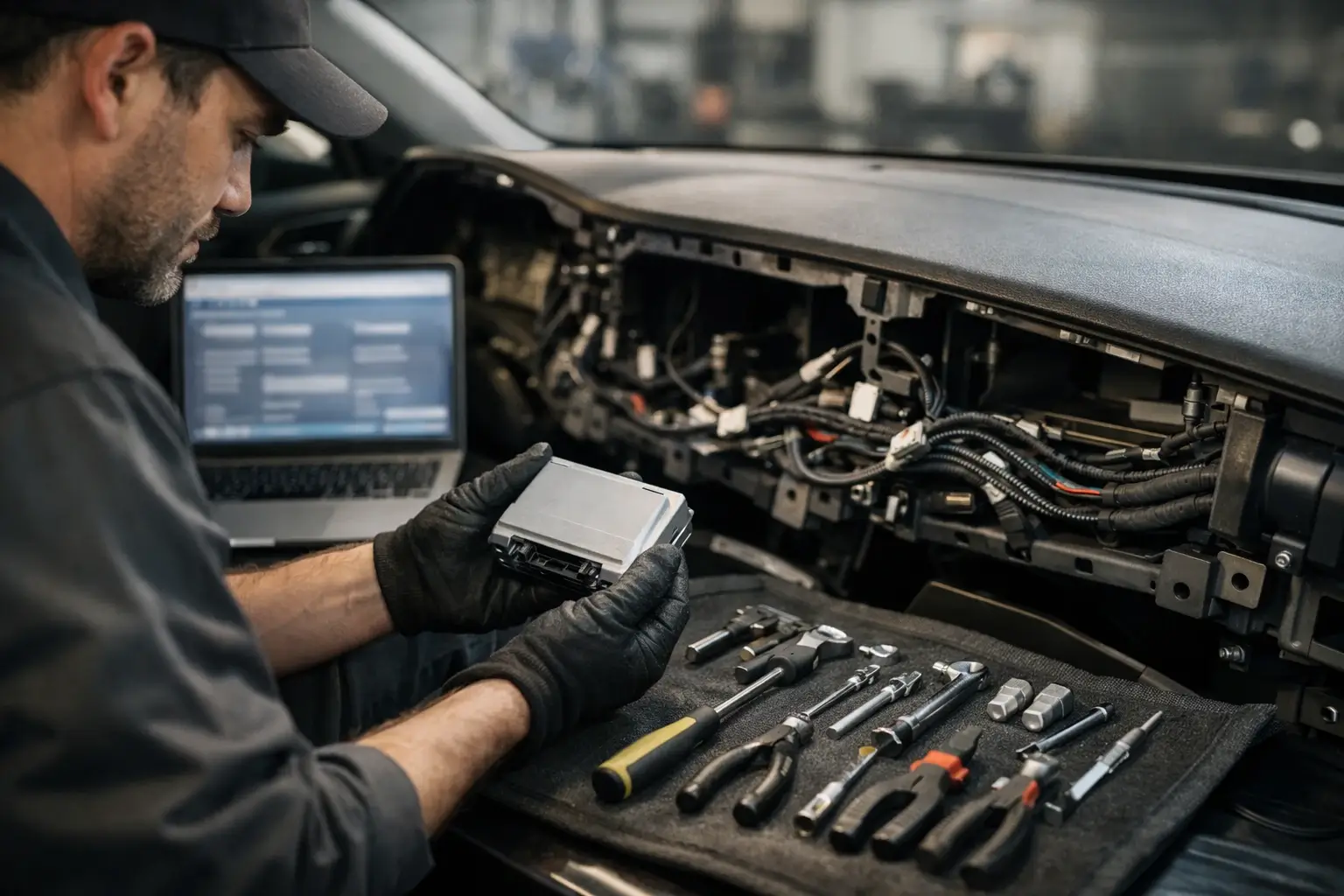
SDVs aim for ECU consolidation and reduction. They group work into domain controllers, then move further to high-performance computers (HPCs) with zone controllers.
From ECUs to centralized and zonal computing
Think of it like a house renovation. Instead of dozens of extension leads and adapters, you run a cleaner main board and feed power where it’s needed.
Here’s the simple picture:
Past:     Many ECUs everywhere
Now:      Domain controllers (grouped by function)
SDV path:  HPCs (central brains) + zone controllers (local hubs)
That’s the heart of modern E/E architecture and cross-domain E/E architecture.
Networks matter: CAN vs modern high-speed networks
A lot of older in-car networking relies on CAN (Controller Area Network). CAN works well for many tasks, but it’s tied to fixed links designed at build time.
That fixed wiring brings real-world pain. Wiring can be extremely heavy, hard to assemble, and tough to diagnose after damage, which links directly to repair costs and fault-finding time.
SDVs lean on high-speed networks and modern automotive networking (often including Automotive Ethernet) to carry more data and allow more flexible connections.
What “zonal” means in real life
Zonal architecture puts small “local managers” near the doors, boot, dash, and rear. Those zone controllers handle nearby sensors and devices, then report to the central compute domains.
The SDV software stack (what runs the car)
SDVs run a layered software stack, more like a computer than a traditional ECU farm. Common layers include an embedded OS (QNX or Linux), middleware, application frameworks, and apps.
A simple way to picture it:
- Embedded OS (QNX, Linux)
- Middleware (shared services for different systems)
- Application frameworks
- Apps (infotainment, comfort, ADAS features, connectivity)
Separation of hardware and software
Hardware/software separation (decoupling) matters because it stops features from being trapped inside one box. With modular software architecture, car makers can change software without rewriting everything for each ECU.
This is where “software-first platform” thinking shows up. The hardware supports headroom, while the software decides what the car can do next.
Virtualization, containerization, and safety isolation
Here’s the big safety idea: keep the “fun” side away from the “must not fail” side. Virtualization and containerization can isolate safety-critical functions from noncritical ones like infotainment.
That separation helps when something glitches. A crashed music app shouldn’t touch braking or steering logic.
OTA updates + connectivity (the capability that makes it “defined”)
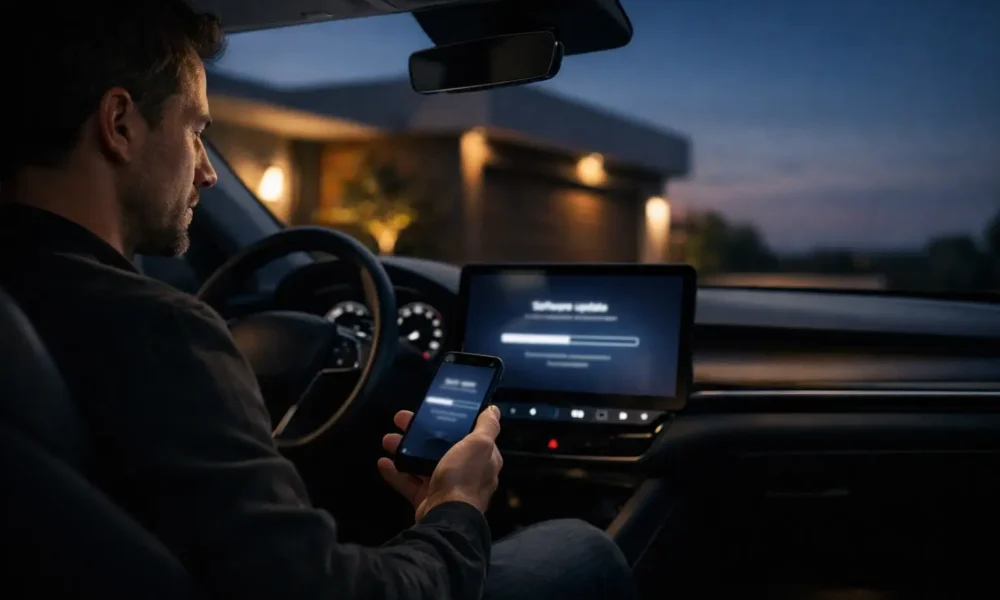
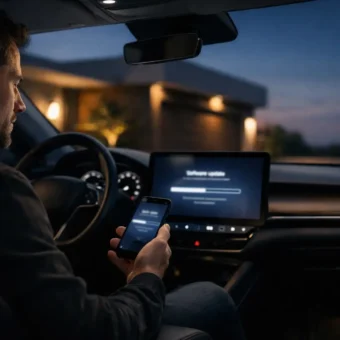
OTA updates (over-the-air updates or upgrades) let the car receive new software without a workshop visit. OTA ties to bug fixes, feature adds, and security work, and it can also deliver safety fixes without physical recalls.
Connectivity is the other half. Vehicle-to-cloud links allow remote diagnostics, real-time data sharing, and services that depend on continuous connectivity.
A plain OTA flow looks like this:
Engineer builds update -> tests it -> signs it
Cloud sends package -> car checks signature -> installs
Car reports status -> rollback if needed
That “signing and checking” piece matters for trust.
What OTA can update
Some updates feel obvious, like infotainment upgrades and app-like feature delivery. Others can touch driving modes, efficiency tuning, battery optimisation, and security patches.
Good brands also use OTA for fixes without dealership visits. That can save time, but only if the maker supports the car for long enough.
V2X and smart infrastructure
V2X communication means the car talks with other vehicles (V2V) and infrastructure (V2I). This can include real-time interaction with traffic lights and road systems.
In practice, this can support warnings, routing, and traffic flow help. It also increases the number of external connections, so security work matters even more.
What SDVs enable for drivers (benefits)
The best SDV gains feel boring in a good way. Fewer surprise faults, fewer wasted trips, and clearer control over what the car’s doing.
Personalization that actually sticks
Personalization isn’t just a saved radio station. In stronger SDVs, customizable UX and adaptive interfaces can follow your profile, adjust settings, and keep improving through software updates.
That said, we should stay realistic. Not every brand will keep adding new features, and some will lock them behind paywalls.
Predictive maintenance + fewer surprises
Predictive maintenance is software watching vehicle health and flagging issues early. Combine that with remote diagnostics, and you can spot problems before they become “why’s it doing that noise?” moments.
Safety improvements over time
OTA can deliver safety improvements and bug fixes through software rather than recalls. Centralized design can also support better ADAS support and self-driving capabilities over time.
What SDVs enable for automakers (and why that matters to you)
Car makers like SDVs because they can add post-sale features. This includes feature activation and “features as a service,” including subscriptions or individual purchase.
That business model lands on you. So it’s worth checking what’s included, what’s optional, and what stops working if you cancel.
Feature activation + subscriptions
Everyday examples include advanced cruise control, heated seats, performance modes, bought or subscribed to after sale. OTA updates also tie into pricing models where features arrive as a service.
This is where confusion starts. A spec sheet can look generous, but the small print may say “trial” or “requires plan.”
Faster development, simulation, digital twins
SDVs push car software closer to the tech world’s release rhythm. Virtualization and simulation help, and SDV foundations often include centralized compute domains, high-speed networks, cross-domain features, and real-time data sharing.
You’ll also hear digital twins and virtualized engineering environments. That means engineers test software in a virtual car before real cars roll out.

The SDV maturity roadmap (where your “next car” fits)
Not every SDV looks the same in 2026. Some cars only get basic fixes, while others add features and smarter behaviour across systems.
Connected → Augmented → Adaptive → Agentic
Four stages often described are Connected, Augmented, Adaptive, and Agentic.
Connected: you’ll see basic connectivity and OTA firmware fixes, but the experience stays mostly static. Augmented: post-sale features show up mainly in infotainment, and the car gets more customisable.
Adaptive: the vehicle becomes contextually aware and can adapt using cross-domain functions and AI help. Agentic: the car acts as a proactive intelligent agent, more closely integrated with digital life.
Risks, trade-offs, and trust
More software brings more attack surface. Expanded cybersecurity attack surfaces and data privacy concerns grow as SDVs add interfaces and collect more data.
A good SDV should also show its homework. That means clear update support, clear privacy controls, and a plan for when an update goes wrong.
Cybersecurity by design
Cybersecurity by design means security features sit inside the platform, not added later. Common examples include secure boot, encrypted communication, real-time monitoring, and intrusion detection systems.
Rules now push this further. UNECE R155 and R156 have become mandatory for all new vehicles produced from July 2024, with R155 focused on cybersecurity and R156 on software update management.
You may also hear ISO/SAE 21434 for cybersecurity engineering and ISO 26262 for functional safety.
Data privacy and consent
Cars can collect data from sensors, usage patterns, and connected services. That raises privacy concerns and the need for strong data security practices to keep user trust.
When you shop, look for control. You want simple settings, plain policy language, and an easy way to switch off nonessential data sharing.
Update failures + feature paywalls
Updates can fail. A good maker plans for rollback, clear error messages, and support that doesn’t vanish after year three.
Paywalls also matter. If key comfort features sit behind subscriptions, resale value and “what you actually own” get messy.
How to shop for an SDV (buyer checklist)
You don’t need to be an engineer. You just need a short list of checks that cut through sales talk.
SDV checklist (use this at the dealer)
- What’s the software update support window in years?
- How often do OTA updates arrive, and what do they usually change?
- Is there a rollback plan if an update causes faults?
- Which features are included, and which are subscriptions or pay-per-feature?
- Can you control data sharing and connected services easily?
- Does the brand mention secure boot, encryption, and intrusion detection?
Questions to ask before you buy
Ask the salesperson to show you the update screen. Ask what happens if you skip updates for months, or if the car loses connectivity.
Ask about warranties in plain terms. If a software issue causes a drivability problem, who owns the fix, and how fast do they act?
What to look for in the spec sheet
Look for OTA updates, vehicle-to-cloud services, and clear ADAS update support. Look for words like zonal architecture, zone controllers, or centralized computing if the brand gets specific.
If the spec sheet stays vague, that’s a signal too. A serious SDV program usually explains its platform, at least at a high level.
Glossary (quick translations)
- ECU (electronic control unit): a small computer for one vehicle function.
- E/E architecture: how electrical parts and computers connect across the car.
- Zonal architecture: zone controllers handle local devices and feed central computers.
- HPC (high-performance computer): a central computer running many functions at once.
- OTA updates: software updates sent over the air, not by cable.
- V2X: vehicle communications with cars and infrastructure (V2V, V2I).
- Middleware: shared software services used by multiple apps and systems.
Why your next car will be one
SDVs aren’t a niche idea anymore. The platform basics – centralized computing, zonal wiring, OTA updates, and cloud services – are becoming the normal way to build modern cars.
For you, the win is simple. More fixes without hassle, clearer feature growth, and better odds that the car you bought won’t feel outdated too fast.
The catch is also simple. Ask the right questions up front, so “software-defined” doesn’t turn into “surprise bill-defined.”
FAQs
What is a software-defined vehicle (SDV) in simple terms?
An SDV is a car where many features come from software that can be updated after purchase. It uses centralized computing, a layered software stack, and connectivity so the car can change over time. Hardware still matters, but software decides a lot of day-to-day behaviour.
How is an SDV different from a connected car?
A connected car can use apps, data, and online services, yet still stay mostly fixed once built. An SDV is designed for updates after purchase that can change features across the vehicle. The difference is long-term upgradeability, not just having a modem.
Are traditional cars software-defined vehicles?
Most traditional cars use many ECUs with software tied closely to each hardware box. That setup makes changes after production harder and limits feature growth. SDVs separate hardware and software more cleanly, support OTA updates, and plan for ongoing changes across the vehicle’s life.
Does having ADAS mean my car is an SDV?
ADAS can exist in both older and newer architectures. A car can have driver assistance features yet still rely on fixed ECUs that don’t support broad software change. SDVs are built for ongoing updates and cross-system changes, not just one set of ADAS features.
What can be updated with OTA updates in an SDV?
OTA updates can deliver bug fixes, security patches, infotainment upgrades, and sometimes changes to driving modes or efficiency settings. What’s possible depends on the platform design and safety rules. A good maker also designs a rollback plan, so a bad update doesn’t strand you.
Can SDVs add new features after I buy the car?
Yes, many SDVs can add post-sale features because the platform supports software growth after production. That can mean new apps, comfort features, or upgrades that arrive via OTA. Some brands include features for free, while others sell them as subscriptions or one-off purchases.
What is zonal architecture and why does it matter?
Zonal architecture uses zone controllers in different areas of the car to manage local sensors and devices, then send data to central computers. It can reduce wiring complexity and help systems work together more cleanly. In SDVs, it supports centralized computing and easier long-term updates.
Why are automakers reducing the number of ECUs?
Too many ECUs add weight, wiring, and complexity, and they can make faults harder to trace. Central computers and zone controllers can run more functions with fewer boxes. That supports a cleaner E/E architecture and makes software updates easier to deliver across multiple systems over time.
Are SDVs more secure or more hackable?
SDVs add connectivity, which can increase risk if security is weak. At the same time, they can improve security through secure boot, encrypted communication, real-time monitoring, and intrusion detection. The outcome depends on design quality, update discipline, and how the maker manages threats over the car’s life.
How do SDVs protect safety-critical systems from infotainment issues?
Many SDVs use virtualization and containerization to isolate safety-critical functions from noncritical ones like infotainment. That separation helps stop a fault in one area from affecting braking, steering, or other critical systems. It also supports stronger security boundaries inside the vehicle’s software stack.
Will SDVs make cars more expensive or cheaper to build?
SDVs can add cost in computing power and software work, but they can also cut cost by reducing ECU count and wiring complexity. The pricing you see may also depend on subscriptions and feature unlocks. For buyers, the key is total cost over the years, not list price alone.
What new business models do SDVs enable (subscriptions, feature unlocks)?
SDVs support features as a service, where drivers can activate options later through subscriptions, pay-per-feature, or one-time purchases. Car makers can also sell post-sale features and app-like upgrades. This can help some drivers, but it can also create paywalls, so the fine print matters.
What is the SDV maturity framework and what stage are cars in today?
The SDV maturity framework describes four stages: Connected, Augmented, Adaptive, and Agentic. Early-stage cars focus on connectivity and basic fixes, while later stages add post-sale features and smarter cross-system behaviour. Today, many cars sit in Connected or Augmented, with higher stages still emerging.
Do SDVs require constant internet connectivity?
Not always, but many SDV features work best with regular connectivity. OTA updates, cloud services, and remote diagnostics rely on a strong link now and then. If coverage is weak, the car should still drive safely, but you may lose live services and delay updates until you reconnect.
How long will my car receive software updates?
Update support varies by brand and model, and it’s often not explained clearly at purchase. Ask for the support window in years, not vague promises. Also ask what updates cover: security, bug fixes, and feature updates may follow different schedules, and some may stop earlier than others.




[…] Software-defined vehicles pushed this faster. More features now depend on software, and software changes more often than metal. […]
[…] and is portable. It’s ideal for monitoring a car you don’t own, such as a company vehicle or a teenager’s first car. Battery life typically runs between two and six weeks depending on how frequently it […]