




Truth About EV Charging on Road Trips: Real Owner Experiences (and How to Plan Like a Pro)
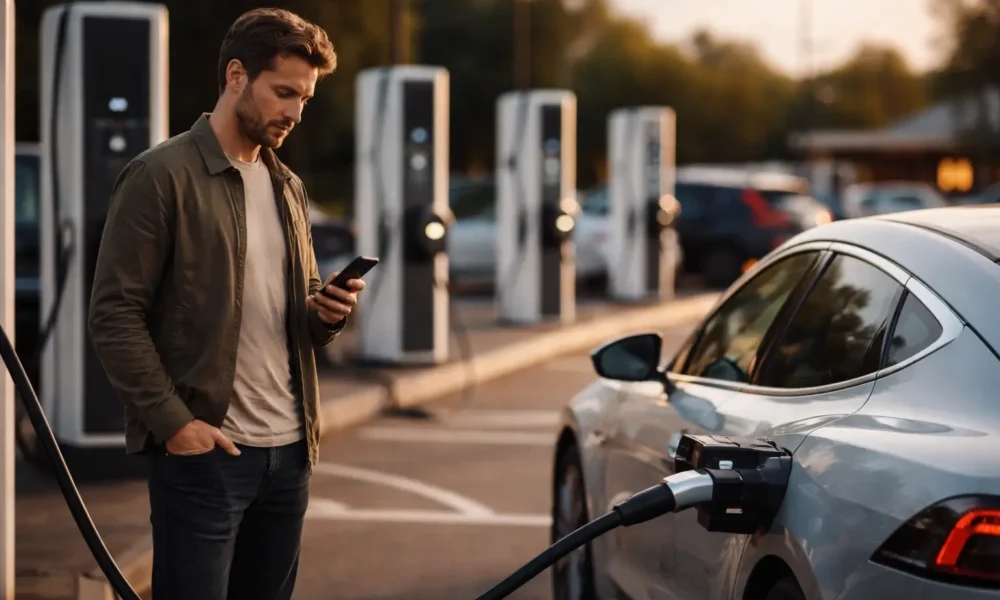
Road trip charging isn’t magic. It’s planning, backups, and a bit of patience.
Table Of Content
- What EV road trip charging is really like (owners: the good, the annoying, the fixable)
- The 3 things that decide your trip: charger density, stall count, and payment access
- Quick reality stats to frame expectations
- The basics you must understand before you plan
- kW vs kWh (and why your car’s max matters)
- Charger speeds: slow vs fast vs rapid vs ultra-rapid
- Connectors and compatibility: Type 2, CCS, CHAdeMO, Superchargers, adapters
- Pre-trip checklist that prevents 90% of road trip stress
- Charge plan: when 100% is worth it vs the usual 80% rule
- Tyres, load, cable, adapters, lights, brakes
- Preconditioning (cabin + battery) for range and faster charging
- Planning your charging stops (the method competitors hint at, but don’t fully map)
- Choose your tools: Zap-Map, ABRP, PlugShare, in-car nav
- The buffer rule: plan first stop at about 20%-30%, keep wiggle room
- Prefer multi-stall sites and add backups
- Picking chargers by speed your car can accept
- On-the-road charging strategy that saves time
- The 20%-80% sweet spot (charging curve)
- How long will you actually stop? (50 kW vs 150 kW examples)
- What to do at busy chargers: queue etiquette + when to switch sites
- Payment, apps, and “why is this so fiddly?” (owners’ biggest friction point)
- Access methods: contactless, app, RFID, plug-and-charge
- Before you leave: set up apps and payments to avoid poor signal pain
- What good looks like: “charge and go” expectations
- Cost control on road trips (without turning the trip into a spreadsheet)
- Typical cost bands: home vs destination vs rapid
- Check price per kWh before plugging in + watch for fees
- When destination charging wins (overnight, less stress, often cheaper)
- Range killers on road trips (and how owners prevent surprise stops)
- Weather: cold slows charging and reduces range; wind and rain matter
- Speed, regen, eco mode, cruise control
- Load, roof boxes, trailers: plan extra stops
- Troubleshooting playbook (your biggest gap vs competitors)
- Charger is out of order or occupied: steps to recover fast
- Payment or app fails: fallback options
- Charging is slow: common causes
- Destination charging checklist (hotels, rentals, friends)
- Filter for EV charging, confirm access and cost, ask about sockets
- Overnight charging plan = calmer mornings
- The calm way to think about it
- FAQs
- How do I plan EV charging stops on a road trip?
- When should I stop to charge (what battery %)?
- Is it faster to charge from 20% to 80%?
- How long does rapid charging take (50 kW vs 150 kW)?
- Do I need a long-range EV for road trips in the UK?
- What apps are best for finding reliable chargers?
- What payment methods do public chargers use?
- How much does it cost to charge on a road trip vs at home?
- What should I do if a charger is broken or there’s a queue?
- Does cold weather reduce range and slow charging?
- Should I charge to 100% before leaving?
- How do I find hotels with EV charging and check the cost?
If you’re new to EVs, the loudest voices are often the least helpful. Forums can make every charger sound broken, and ads can make every stop sound effortless.
I’m David Wright. I write about cars for BuzzyTimes.co.uk, and I keep this practical.
What EV road trip charging is really like (owners: the good, the annoying, the fixable)
Most EV trips go fine. The stress usually comes from small, avoidable surprises.
Think of public charging like airport security. Most days are smooth, but one slow queue can throw your mood off.
The 3 things that decide your trip: charger density, stall count, and payment access
Charger coverage matters, but stall count matters more. One “ultra-rapid” unit sounds great until it’s out of order or already taken.
I’d rather stop at a hub with eight decent stalls than a site with one very fast stall. More stalls means less queue risk, and it gives you options if one unit is fussy.
Payment access is the third leg. If you can’t start a charge quickly, speed ratings don’t help.
UK rules are pushing things the right way. The Public Charge Point Regulations guidance sets out contactless expectations for many new and higher-power public chargers, plus uptime rules for rapid networks.
Quick reality stats to frame expectations
Cost gaps are real. One UK report put average home electricity at about 32p/kWh and public charging at about 52p/kWh, with big variation depending on where and how you charge.
That gap shapes how owners plan. If you can start with a solid home top-up and finish with destination charging, your public spend can drop fast.
The basics you must understand before you plan
Two ideas matter most: power and energy.
Get these right and the rest feels simpler. Get them wrong and you’ll chase the wrong chargers.
kW vs kWh (and why your car’s max matters)
kW is “speed.” kWh is “amount.”
A charger’s kW rating is like the tap. Your battery size in kWh is like the bucket.
Here’s the catch. Your car has a max DC rate, and it may be lower than the charger’s headline number, plus it changes with battery percentage and temperature.
Charger speeds: slow vs fast vs rapid vs ultra-rapid
AC chargers suit long stops. DC chargers suit short stops.
A rough UK mental model helps:
- 7 kW to 22 kW (AC): good for hotels, longer parking, overnight
- 50 kW+ (DC rapid): good for motorway stops
- 150 kW to 350 kW (DC ultra-rapid): best when your car can take it
Speed labels don’t guarantee your result. Your car’s limit and its charging curve can cap what you get.
Connectors and compatibility: Type 2, CCS, CHAdeMO, Superchargers, adapters
Know your plug types early. It saves real time at the curb.
In the UK you’ll most often see:
- Type 2 for AC
- CCS for DC rapid
- CHAdeMO on some older cars and sites
- Tesla Superchargers (access depends on site and car)
Some sites use tethered cables. Others expect you to bring your own Type 2 cable, and some cars may need adapters for certain setups.
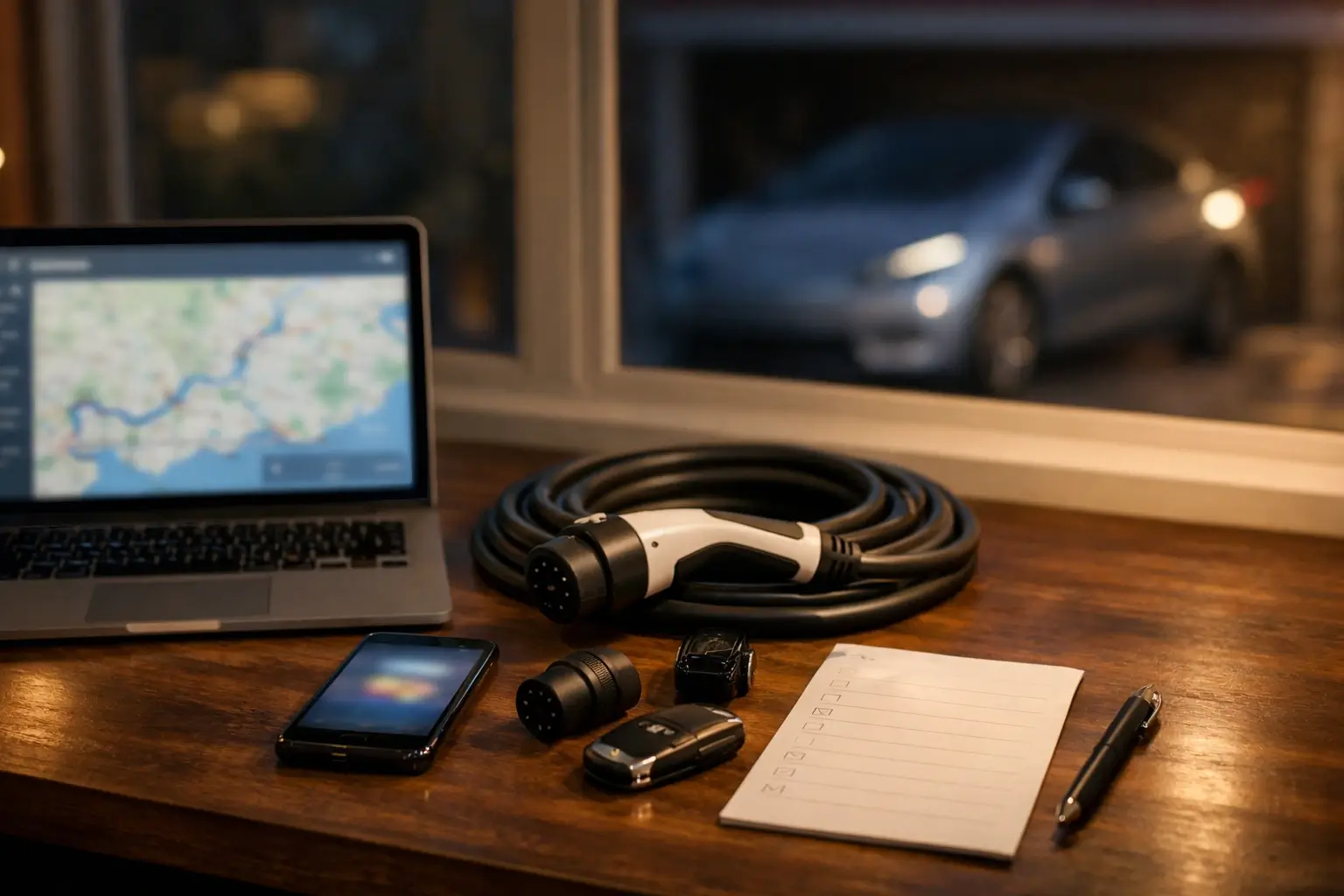
Pre-trip checklist that prevents 90% of road trip stress
Small checks beat big panic. I treat this like tyre checks before a long motorway run.
Do it once, then relax. You’re not trying to be perfect, just prepared.
Charge plan: when 100% is worth it vs the usual 80% rule
Start smart with battery percentage. Most days, I begin with a healthy charge and plan my first stop before I’m low.
Charging to 100% can make sense. It’s useful for a long first leg or when charger coverage is thin early on, but it often takes longer than people expect on DC.
Tyres, load, cable, adapters, lights, brakes
Keep it boring on purpose. Boring saves money and keeps warranties and safety worries away.
I check:
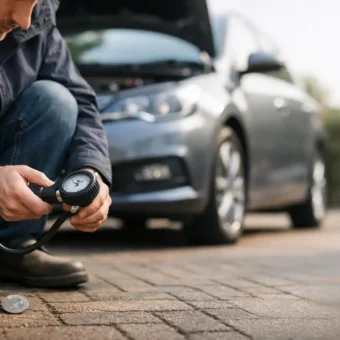
- tyre pressure and tread depth for the expected load
- lights and brakes
- the right cable (and any adapter)
- a clean, working charge port
Heavy load changes range. Roof boxes, bikes, and trailers can push you into an extra stop.
Preconditioning (cabin + battery) for range and faster charging
Cold packs a double hit. It can cut range and slow DC charging.
Preconditioning helps. If your EV supports it, warming the battery before a rapid stop can improve charge speed, and warming the cabin while plugged in can save battery on the road.
Planning your charging stops (the method competitors hint at, but don’t fully map)
Plan like a pilot. You want a main route and clear alternates.
I don’t plan every minute. I plan the points where a bad charger could hurt me.
Choose your tools: Zap-Map, ABRP, PlugShare, in-car nav
Use more than one map. Apps disagree, and data lags happen.
My usual stack looks like this:
- Zap-Map for UK filters, pricing, and charger types
- PlugShare for user ratings and “what it’s really like” notes
- ABRP (A Better Routeplanner) for stop spacing by your car model
- Google Maps or Waze for quick nearby checks
- In-car navigation for car-aware routing when it’s good
E.ON Next lists these same core tools and the places you’ll typically find chargers, like service stations, supermarkets, retail parks, gyms, pubs, and garden centres.
The buffer rule: plan first stop at about 20%-30%, keep wiggle room
Buffers stop bad choices. I plan my first charge stop around 20%-30% battery.
That’s not fear. It’s flexibility when a charger is in use, out of order, or priced higher than expected.
Prefer multi-stall sites and add backups
Backups are the real secret. I save two alternates near each main stop.
Busy sites happen. A government research report found drivers often use apps to check if units are working, in use, or out of order, but the status can change fast.
Picking chargers by speed your car can accept
Match the charger to your car. A 350 kW label doesn’t mean you’ll get 350 kW.
Your result depends on:
- the charger’s real output
- your car’s max DC rate
- your state of charge (SoC)
- battery temperature
That mix matches what owners report in real life.
On-the-road charging strategy that saves time
Time savings come from habits, not from hero moves.
You’re aiming for smooth stops, not perfect stops.
The 20%-80% sweet spot (charging curve)
Charging slows as you fill up. That’s the charging curve.
Many EVs take energy fast at lower SoC, then taper. That’s why 20%-80% often beats chasing 100% on rapid DC when you want to get moving again.
How long will you actually stop? (50 kW vs 150 kW examples)
Expect wide variation. Two “rapid” units can behave differently.
As a rough guide, a 50 kW unit might take 40-60 minutes to reach about 80%, while a 150 kW unit might do a similar top-up in 20-30 minutes, if your car can accept it.
What to do at busy chargers: queue etiquette + when to switch sites
Queues aren’t rare at peak times. Owners handle it with simple rules.
I follow this:
- don’t block bays once you’re done
- if you’re already high SoC, consider moving on
- if the site has one or two stalls and a queue forms, switch to a hub with more stalls
A Highways England survey found many EV drivers would accept a wait, but long delays can push people to consider diversion or reassessing routes.
Payment, apps, and “why is this so fiddly?” (owners’ biggest friction point)
Payment pain is real. It’s not you being “bad at EVs.”
Phone signal drops. Apps sign you out at the wrong time.
Access methods: contactless, app, RFID, plug-and-charge
You’ll see four common options:
- contactless card readers
- app payment
- RFID cards
- plug-and-charge (on some cars and networks)
These are the common access methods, and it matches what owners face on trips.
Before you leave: set up apps and payments to avoid poor signal pain
Setup at home matters. Do it on Wi-Fi, not in a windy car park.
I install the key network apps, add a card, and test login. Then I screenshot any account details I might need, because poor signal can turn a “two minute” start into a ten minute mess.
What good looks like: “charge and go” expectations
UK rules are pushing “walk up and pay.” The guidance says many new public charge points 8 kW and above deployed after 24 November 2024, plus public charge points 50 kW and above, must offer contactless payment, with limits on “members only” access for ad-hoc users.
That matters for trust. It cuts the feeling that you’re stuck in a maze of apps just to buy electricity.

Cost control on road trips (without turning the trip into a spreadsheet)
Cost control can be simple. You’re just avoiding bad surprises.
Think “price before plug.” Then you’re fine.
Typical cost bands: home vs destination vs rapid
Home is usually cheapest. Rapid public charging is often higher.
E.ON Next gives a plain-English example range for home and rapid charging, and it matches what many owners see: home tends to be lower, rapid tends to be higher, and destination charging can sometimes be free or close to home rates.
Check price per kWh before plugging in + watch for fees
Price transparency is now part of the rules. The guidance says the maximum price must be shown clearly in pence per kWh, and the price shouldn’t rise above the advertised maximum once charging starts.
Also watch for extras. Connection fees and idle fees can change the deal.
When destination charging wins (overnight, less stress, often cheaper)
Overnight charging is the calm option. You wake up full and skip the morning hunt.
E.ON Next points out hotels, B&Bs, and holiday rentals often offer charging, and it’s one of the easiest ways to reduce on-the-road stops.
Range killers on road trips (and how owners prevent surprise stops)
Range drops have causes. They’re not mysterious.
Most are predictable. You can plan around them.
Weather: cold slows charging and reduces range; wind and rain matter
Cold changes battery behaviour. Low temperatures can slow battery chemistry, reduce range, and slow charging. Wind can also cut range.
Rain adds load too. Wipers, headlights, and extra rolling resistance can nudge consumption up.
Speed, regen, eco mode, cruise control
Speed is the big lever. Motorway pace can raise energy use fast.
Regen helps most when you drive smoothly. Cruise control can help keep things steady, and eco mode can soften the car’s appetite for power.
Load, roof boxes, trailers: plan extra stops
Drag costs energy. A roof box can push you into another stop.
Trailers do the same. Plan shorter legs and bigger buffers when towing or carrying bikes.
Troubleshooting playbook (your biggest gap vs competitors)
Problems feel bigger when you’re tired, so I keep fixes simple.
Treat it like a misbehaving petrol pump. Try one thing, then move.
Charger is out of order or occupied: steps to recover fast
Do this in order:
- check the next stall on the same site
- check live status in another app
- move to your saved backup site
- avoid waiting until you’re low SoC
Stall count saves you here. That’s why hubs beat single units most days.
Payment or app fails: fallback options
Try these:
- contactless card if the unit supports it
- a second app or roaming option (like Octopus Electroverse or a network umbrella app)
- a different stall on the same site
- a different site
UK rules push wider contactless access for many higher-power chargers, which should reduce “app only” traps over time.
Charging is slow: common causes
Slow charging usually has a reason. Common ones are high SoC, a cold battery, a car limit, or a shared-power site.
Charge rate depends on charger power, your car’s acceptance rate, SoC, and temperature. If you’re already above 80%, moving on can save time.
Destination charging checklist (hotels, rentals, friends)
Destination charging lowers stress. It turns “where do I stop next” into “I’ll charge while I sleep.”
It also helps cost control. You avoid the most expensive rapid sessions.
Filter for EV charging, confirm access and cost, ask about sockets
I always confirm three things:
- is it for guests only, and do I need to register
- what’s the price per kWh (or is it free)
- what connector is there, and do I need my own Type 2 cable
Apps let you filter for accommodation charging. This exact approach works well using tools like Zap-Map and PlugShare.
Overnight charging plan = calmer mornings
Morning plans work better with a full battery. It also protects your buffer, which is your safety net.
The calm way to think about it
EV road trips reward basics. Start with a buffer, use more than one app, and favour multi-stall sites.
Trust grows when rules back you up. UK guidance sets clearer expectations on pricing, contactless access, and rapid-network uptime, which should make public charging feel less like guesswork over time.
FAQs
How do I plan EV charging stops on a road trip?
Use a route planner, then add backups. I plan my first stop for 20%-30% battery, pick multi-stall rapid sites that match my car’s max DC rate, and save two nearby alternatives. I also check live status and pricing before I roll.
When should I stop to charge (what battery %)?
Stop before you’re low. On most trips I aim to arrive at a charger with about 20% left, and I start looking for options from 30%. That buffer covers detours, hills, wind, and a broken unit without turning the drive into panic.
Is it faster to charge from 20% to 80%?
Usually, yes. Most EVs charge quickest at low to mid state of charge, then slow down as the battery fills. If you’re using rapid DC, a 20%-80% session often gives the best miles per minute, while 80%-100% can take a long time.
How long does rapid charging take (50 kW vs 150 kW)?
Expect bigger gaps than the label. As a rough guide, a 50 kW unit might take around 40-60 minutes to get from low battery to 80%, while a 150 kW unit can do a similar top-up in about 20-30 minutes, if your car can take it.
Do I need a long-range EV for road trips in the UK?
Not always. Many UK long drives sit inside the real-world range of today’s mid-range EVs, as long as you plan a couple of rapid stops. A bigger battery can cut the number of stops, but it doesn’t fix queues, payment issues, or charger gaps. Planning matters more.
What apps are best for finding reliable chargers?
I don’t bet on one app. In the UK I keep Zap-Map for filters and pricing, PlugShare for user notes, and ABRP for stop planning. I also check Google Maps or Waze, plus my car’s in-car navigation, to cross-check live status and stall count.
What payment methods do public chargers use?
Most sites offer a mix. You’ll see contactless card readers, app payment, RFID cards, and sometimes plug-and-charge, where the car and network sort billing for you. UK rules also push contactless and clear pricing on many new or higher-power units, so ad-hoc use should get easier.
How much does it cost to charge on a road trip vs at home?
Public charging often costs more. One UK driver survey report put average home energy around 32p per kWh and public charging around 52p per kWh, with wide swings by network and speed. On a trip, check pence-per-kWh plus any connection or idle fees before you plug in.
What should I do if a charger is broken or there’s a queue?
Move fast, not stubborn. I check the next stall, then the next site, before I burn time. That’s why I save two backup chargers within 10-15 minutes, and I arrive with a buffer. If there’s a queue, pick the site with more stalls, not just higher kW.
Does cold weather reduce range and slow charging?
Yes, it can. Cold temperatures slow battery chemistry, so you may see fewer miles and slower DC charging, especially early in a drive. Heating, demisting, and cold tyres add extra load. Preconditioning while plugged in helps, and a bigger buffer between stops keeps plans steady.
Should I charge to 100% before leaving?
Sometimes, yes. I charge to 100% when I’m starting with a long first leg, or when I know the next stop is thin on chargers. For normal rapid charging, 100% often costs time because the last 20% fills slowly, so 80% is usually the sweet spot.
How do I find hotels with EV charging and check the cost?
Filter, then confirm. I use Zap-Map, PlugShare, and booking filters to find hotels or holiday rentals with destination charging, then I call or message to ask: is it working, is it for guests only, what’s the price per kWh, and do I need my own Type 2 cable.




[…] not a perfect measure of every single transaction, but it’s widely used because it reflects real buyer experiences: how people saved, what they paid, and what held them […]
[…] insurance if your trip has real risk (scooters, hikes, long buses). Keep it […]
[…] you want, we can turn your self-assessment scores into a simple 14-day plan that fits your real schedule, including sleep anchors that support your circadian […]
[…] assistance can make homeownership possible sooner, but it only works well when you treat it like a real part of your mortgage plan, not a last-minute […]