




Buy a Used Car in January: Why It’s a Sneaky-Good Month (and How to Negotiate)

January can feel like a bad month. Money’s tight. You’re tired of sales talk. You also don’t want to mess up a big purchase.
That mix leads to the same spiral. Too many tabs open. Too many opinions. Too many terms that sound important.
Here’s the calmer truth. Buy a used car in January can work well because it’s often a quieter season with fewer buyers. That can mean more time, more choice, and more room to negotiate if you turn up prepared.
This article is general information, not personalised advice. Details can change depending on context, and what works for one person may not work for another.
Why January can be a bargain month for used cars
January can be your friend. Demand often drops after Christmas, and some dealers push harder to start the year with sales. That quiet season effect shows up as fewer buyers on forecourts.
That matters for you. Less competition can mean less pressure and more patience from the salesperson. It also gives you time to ask questions without feeling rushed.
The quiet season effect (December to January)
Winter shopping is slower. People focus on Christmas spending, and cold evenings don’t help casual browsing. The upside is simple: fewer buyers can make January used car deals easier to find.
It also changes the mood. A quiet showroom can feel less like a contest. You can check details, do a test drive, and think clearly.
Dealer targets and fresh-year urgency
Targets still exist. Many sales teams work to monthly and quarterly numbers, and that can affect how flexible they are on price near the end of a period. End of month and end of quarter can be helpful timing.
You don’t need to say “targets.” You just need to show you’re ready to buy if the deal makes sense. That alone can change how the chat goes.

The best times within January to negotiate
Timing won’t fix a bad car. But timing can help you get a better deal on a good car. Think of it like shopping for groceries when the store is quiet.
End of month and end of quarter
Late month can work. Dealers may have more flexibility in the last week of the month, and quarter ends (March, June, September, December) can add pressure too.
If you want a simple plan, aim for the last few days of January. Go in ready to make an offer that day.
Weekday shopping beats weekends
Weekdays are calmer. Tuesday to Thursday are often the quietest days on forecourts.
That calm gives you breathing room. You can ask for documents, look closer at condition, and take a longer test drive.
Time of day can help
Early visits give you time. Near closing can also work if a dealer wants to finish the day with a sale.
Don’t overthink it. Pick a time when you won’t feel rushed. Your patience is part of your power.
January negotiation playbook (step by step)
Negotiation sounds scary. It’s really just a clear chat about price, condition, and terms. The key is to keep it simple and stay calm.
Step 1: Price research that actually helps
Start with the market. Look at comparable listings for the same model, year, engine, trim, mileage, and area. That gives you a sense of market value and fair market value.
Bring proof, not vibes. Save three to five listings on your phone. Then you can say, “I’ve seen similar cars priced around £X.”
Step 2: Set your anchor offer and protect your max
Set your budget first. Keep it fixed, and don’t reveal your top number early. The RAC also warns against sharing your top limit while talking to a seller.
Now choose an opening offer. The RAC suggests starting lower than what you’re willing to pay, then moving up if needed.
A simple line helps. “I can offer £X today based on similar listings.” Then stop talking.
Step 3: Use the car’s condition to support a price reduction
Condition is your strongest reason. Look for dents, scratches, scuffed alloys, tired tyres, and worn interior trim. Small issues add up.
Keep it polite and factual. “These tyres will need replacing soon. The alloys are scuffed. That’s why my offer is £X.”
If you want a quick rule, stick to what you can point to. No guessing. No drama.
Step 4: Negotiate the deal, not just the sticker price
Price is only one piece. The RAC notes you can ask for a service or needed repair as part of the deal.
You can also ask for extras that cost you later. Think mats, a full tank, or a warranty extension.
Be smart about “free” add-ons. The AA warns that dealers may “throw in” extras like rubber mats, paint protection, interior protection, or GAP insurance. That can be fine if you wanted them anyway, but it’s not always a bargain.
Step 5: The walk away and follow-up method
Walking away is real power. Being ready to walk away matters.
Here’s how it plays out in normal life. You make your offer. They say no. You say, “No worries, I’ll think on it,” and leave.
This is where the “call you back” moment can happen. They may ring later with a counteroffer, or they may not. Either way, you stayed in control.
A useful tool is silence. Make your offer, then stop. Let them fill the gap.
Step 6: Part-exchange can change the numbers
Part exchange is its own deal. Dealers can shift money between the car price and your trade-in value. That’s why a part-exchange valuation helps.
Try to separate the deals. First agree the price of the car you’re buying. Then talk about the trade-in. It keeps things clear.
A deal structure checklist that keeps you sane
Deals get messy fast. Sales talk jumps from monthly payments to “only today” extras. You need a simple frame.
Use this checklist and keep it calm:
- Asking price: What’s the sticker price today?
- Discount or price reduction: What changes if you buy now?
- Price match: Can they match a similar listing you show?
- Finance: If using finance, what are the interest rate and APR?
- Warranty: What’s included, and can you extend it?
The RAC is clear on one key point. If you’re financing, it can help to negotiate the interest rate and terms, not only the price.
If you’re comparing finance types, keep the terms basic:
- PCP: A plan where you pay monthly, then choose to return, keep, or swap at the end.
- HP: A plan where you pay monthly and own the car after the last payment.
- Loan: A separate borrow-and-pay-back deal from a bank or lender.
Always check affordability. A lower car price can still feel costly if the APR is high.
Don’t buy a “cheap” January car that becomes pricey in February
A low price can hide bigger costs. That’s why checks matter. Think of them like checking the date on milk before you buy it.
The UK checks that protect you (DVLA, MOT, history)
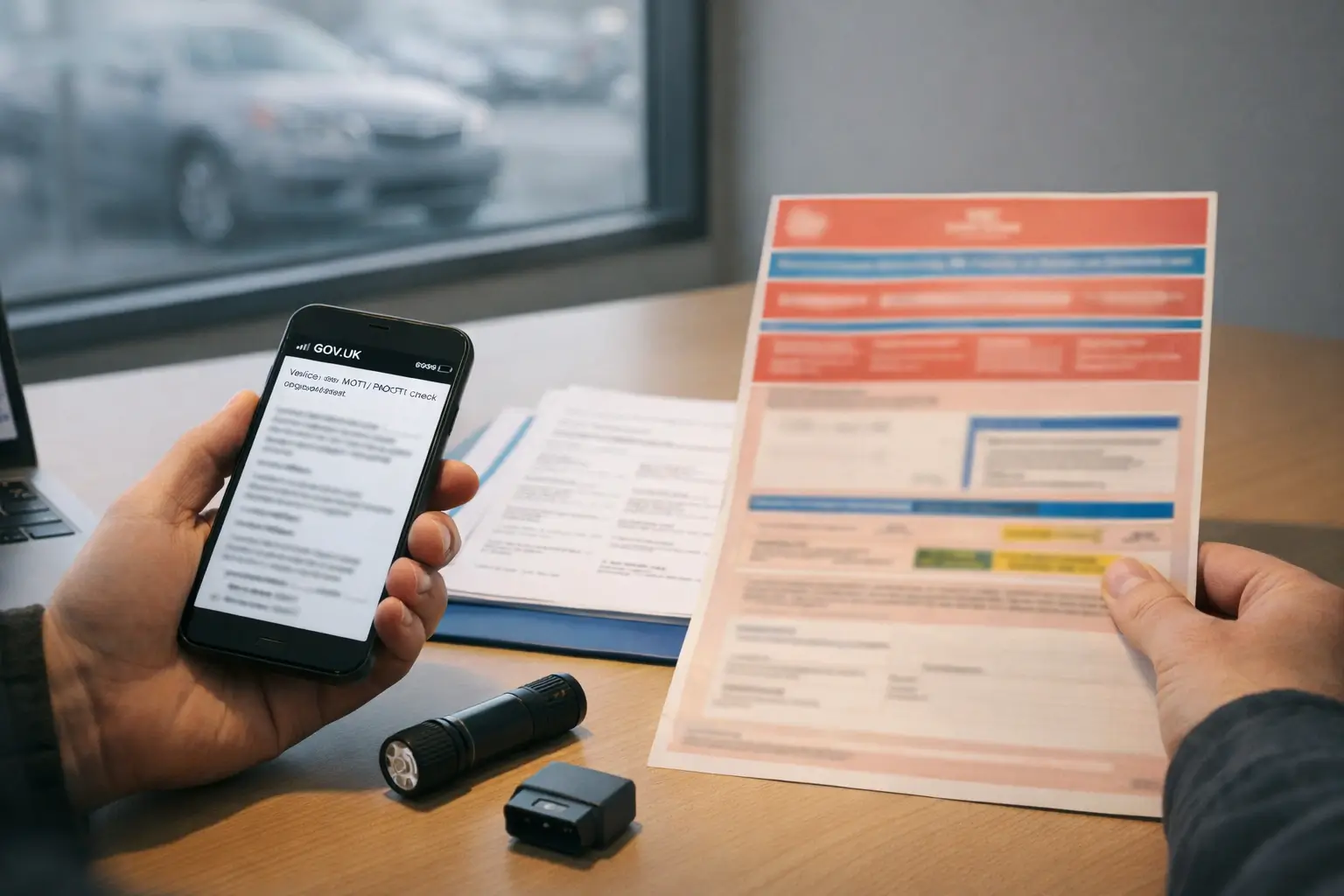
Start with the basics. Check the car’s details with the DVLA, check the MOT history, and get a private history check.
You’ll need the registration number and MOT test number to cross-check details.
The free MOT tool is worth doing. You can check pass or fail results and the mileage recorded at each test.
Then consider a private history check. It can flag issues like stolen status, outstanding finance, a serious accident, or a write-off, plus mileage concerns.
V5C logbook, service history, and receipts
Paperwork matters. Ask to see the V5C logbook and check it matches the details you’ve been given.
Also ask for service history and receipts. A tidy folder doesn’t guarantee a perfect car, but it can show care.
If anything feels off, pause. A weird story today can become your problem later.
Test drive and viewing in daylight
See the car in daylight. It’s harder to spot damage when the car is wet, so try to view it when it’s dry.
Do a real test drive. Aim for at least 15 minutes on different roads, and don’t test drive without insurance.
If you still feel unsure, consider an independent report. That can cost around £120 to £250.
January or wait for the March plate change?
Both can work. It depends on your time, your budget, and what you need.
March and September can be strong months because new plates often bring more part exchanges into the used market. That can mean more used stock that dealers want to shift.
February and August can also be good because dealers may clear old stock ahead of the plate change, sometimes taking a lower price to make space.
Here’s a simple rule set:
- If you need a car soon, January can be fine.
- If you want more choice, March or September may help.
- If you want a pre-plate-change dip, look at February.
Don’t let timing trap you. The right car at a fair price beats waiting for a perfect month.
Dealer vs private seller in January
Both routes can work. The tone and risk feel different.
Dealers often have more structure. You might get a warranty, options for finance, and a clearer process. The AA notes dealers often offer at least a three-month warranty, and you can try for six or 12 months.
Private sellers can be cheaper. They can also be less flexible on process, and you may have less comeback if things go wrong. That’s why DVLA, MOT, and history checks matter no matter who you buy from.
If you want a lower-risk middle ground, look at Approved Used. Common features include multi-point inspections, history and mileage checks, manufacturer-backed warranty, and roadside assistance.
Trust signals that help you feel safer
Trust marks won’t fix a bad car. But they can help you spot sellers who follow clear standards.
One signal is Motor Ombudsman accreditation. It runs CTSI-approved Codes of Practice and has thousands of accredited businesses.
Treat this as one clue, not the whole story. You still need your checks and a clear head.
If you only do three things
Use these three steps. They cut stress and stop most mistakes.
- Check comparable listings and set your budget before you visit.
- Run DVLA and MOT checks, then consider a private history check.
- Make a calm offer, then be ready to walk away.
January doesn’t magically make cars cheaper. But if you buy a used car in January with proof, patience, and clean checks, you give yourself a better shot at a fair deal.
FAQs
Is January a good time to buy a used car in the UK?
Yes, January can be a good time because the market is often quieter after Christmas, with fewer buyers competing for the same cars. That can give you more time, less pressure, and sometimes more flexibility on price and extras, especially if you shop on calmer weekdays.
Timing helps, but only if the car checks out. Always do DVLA and MOT checks before you commit.
How much can you negotiate off a used car in January?
There’s no fixed number. The amount depends on the asking price, how your offer compares to similar listings, and what you find on condition and history. January can help because showrooms may be quieter, but your best tool is still proof of fair market value plus a calm walk away.
Focus on what you can show. Comparable listings and clear condition points beat a random low offer.
Should I wait for the March plate change before buying?
Waiting can help if you want more choice, because March and September often bring more part exchanges into the used market. More stock can mean more options and sometimes better prices. But if you need a car now, a solid January deal can still be a good outcome.
If you can wait a few weeks, February can also be worth watching for clearance on used stock.
Is it better to buy at the end of the month?
Often, yes. Sellers may have monthly targets, so the last week of the month can bring more flexibility on price or extras. It doesn’t mean every deal will be better, but it can improve your odds if you’re ready to buy and can make a clear offer that day.
Pair timing with research. Turning up unprepared wastes the timing benefit.
What’s the best day of the week to buy a used car?
Weekdays are usually calmer than weekends, which can mean more time for questions, paperwork, and test drives. Tuesday to Thursday are often the quietest days on forecourts. A quieter day can also make it easier to negotiate without feeling rushed or crowded.
Pick a day when you’re not in a hurry. Your calm matters more than the calendar.
What checks should I do before paying a deposit?
Do the basics first: check the DVLA details match what the seller tells you, check the MOT history on GOV.UK, and consider a private history check for issues like outstanding finance, stolen status, write-offs, and mileage concerns. Also ask to see the V5C logbook and confirm it matches.
If a seller resists simple checks, treat that as a red flag.
Can I negotiate extras instead of price? What should I ask for?
Yes, and sometimes it’s easier than pushing the sticker price down. Common asks include mats, a full tank, a service, repairs, or a warranty extension. But be careful with “free” add-ons you didn’t want, like certain protection products, because they can make a deal look better than it is.
Ask for extras that save real money. Skip extras you wouldn’t buy on your own.
Can paying by credit card help protect me?
In some cases, yes. Section 75 can apply when a purchase costs over £100 and no more than £30,000, and it can cover the full cost even if you only pay a deposit on a credit card. Coverage depends on how and who you pay, so check the details first.
This is not a reason to rush. It’s a backstop, not a plan.









[…] use a first car checklist and a used car buying checklist you can copy. By the end, buying your first car should feel like a plan, not a […]
[…] Buying stays realistic when your monthly mortgage payment, bills, and a repair buffer fit your budget, after an affordability check. Renting stays realistic when your monthly rent leaves room for bills, savings, and emergencies. […]
[…] more tip that saves real money. Don’t buy storage you’ll outgrow in six months. Low storage tiers can push you into cloud add-ons, which raises total cost of […]
[…] England, Wales, and Northern Ireland, buying can take 12 weeks to eight months depending on chains, mortgage timing, and legal […]