




Deepfake “AI nude” images at school: what victims, parents and teachers can do next
Safety note: This article does not explain how to make deepfake nudes, nudification, or “undress” images. It focuses on harm-prevention, school safeguarding, reporting, and legal basics.
Table Of Content
- What “AI nude images” means (and why it’s not “just a joke”)
- Quick glossary
- How these images spread in schools
- The first 24 hours (do this before anything else)
- First 24 hours checklist (use as a quick plan)
- If you’re the student targeted
- If you’re a parent or carer
- If you’re a teacher or school leader
- Preserve evidence without spreading the harm
- What to record (safe evidence checklist)
- What not to do
- Get it taken down fast (platform reporting + specialist tools)
- Report in-app where it was shared
- If the person is under 18
- If the person is 18+
- When to involve police or child protection
- What the law usually cares about (high-level, by region)
- If minors are depicted, it may trigger CSAM implications
- US: TAKE IT DOWN Act and platform removal timelines
- UK/EU: online safety regulation and Ofcom’s role
- Schools’ duty to respond (US mention)
- School response playbook (what “good” looks like)
- Triage: safety + risk
- Investigation basics (without re-traumatising)
- Supporting the targeted student
- Handling perpetrators
- Communication plan (need-to-know only)
- What to say (scripts that reduce panic and shame)
- Parent to child
- Teacher or DSL to student
- Student bystander
- Prevention (so this doesn’t happen again)
- Policy updates: GenAI + sexting + synthetic media
- Reduce photo harvesting
- Curriculum: consent + digital empathy
- FAQs
- What are “AI nude images” and how are they made?
- Are deepfake nude images illegal if they’re fake?
- What should a student do first if a fake nude of them is shared at school?
- What should parents do in the first 24 hours?
- What should teachers or schools do immediately (who leads the response)?
- How do I report and remove the image from Snapchat, TikTok, or other apps?
- What is NCMEC Take It Down and who can use it?
- What is StopNCII and why is it for adults only?
- Should we contact police, and when?
- How should schools handle the students who created or shared it?
- Can a school discipline students for “AI deepfake nudes”?
- How do we stop re-sharing in group chats without making it worse?
- What if the image is used for blackmail or sextortion?
- How can we prevent this happening again?
What “AI nude images” means (and why it’s not “just a joke”)
This is a fast-moving school crisis. It can feel like everyone has “an opinion” online. You may be scared you’ll say the wrong thing, miss a deadline, or get your child in trouble.
In plain English, deepfake nudes or AI-generated nudes are manipulated images made to look like someone is nude or sexualised when they aren’t. People also call them synthetic nudes, sexualized deepfakes, morphed images, or digitally manipulated nudes and semi-nudes.
This isn’t “banter.” It’s image-based abuse and often sexual harassment, especially in peer-on-peer abuse at school. The harm comes from humiliation, fear, isolation, and the speed of virality.
Quick glossary
- Deepfake: synthetic media that makes a person look like they did something they didn’t (often face swap or generated imagery).
- Nudification / “undress” apps: tools that create fake nude or sexualised images from a normal photo.
- NCII (nonconsensual intimate imagery): intimate images shared or threatened to be shared without consent.
- CSAM (child sexual abuse material): sexual imagery involving a child. If a minor is depicted, many countries treat it with the highest seriousness, even when it’s synthetic or “fake.”
How these images spread in schools
It often starts small. One group chat. One screenshot. One repost.
Then it jumps platforms. Students share in DMs, group chats, Discord-style servers, or gaming spaces. Reposts and screenshots keep it alive, even after deletion.
The first 24 hours (do this before anything else)
Speed matters, but calm matters more. The first day is about safety and control. The aim is to stop re-sharing, record what’s needed, and bring in the right adults.
First 24 hours checklist (use as a quick plan)
- Safety first: check immediate risk (panic, self-harm thoughts, threats, stalking, extortion).
- Stop spread: do not forward, do not “show friends,” do not post “proof.”
- Record key facts: links, usernames, timestamps, where it appeared.
- Tell the school: use safeguarding routes (DSL or equivalent).
- Report to platforms: in-app reporting where it’s posted.
- Use takedown tools: under 18 vs 18+ (details below).
- Decide on police/child protection: based on age, threats, and local law.
If you’re the student targeted
You’re not “in trouble” for being targeted. A fake nude doesn’t become your fault because someone else used your photo. The safest move is to stop the spread, save the basics, and ask one trusted adult to help manage the reports.
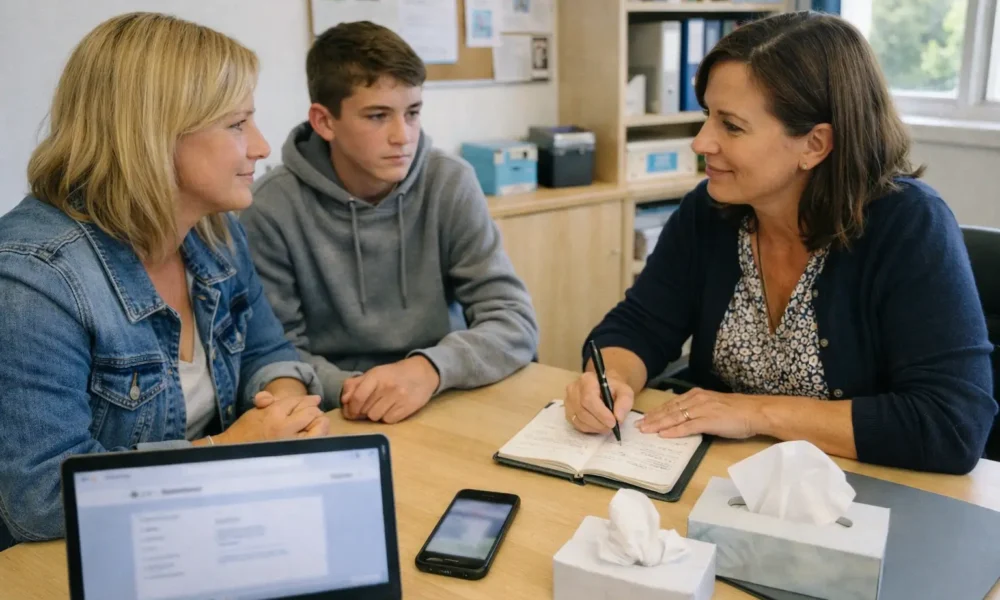
Pick one safe person. A parent, carer, teacher, school counsellor, or safeguarding lead. Let them carry the admin while you focus on wellbeing.
If there are threats or blackmail, treat it like sextortion. Don’t negotiate and don’t send more images to “make it stop.” Offenders may use AI-made images to pressure children for more content or money.
If you’re a parent or carer
Stay steady in your voice. Your child is watching your face for cues. Start with safety, then take control of the reporting steps.
Don’t demand to see the image. That can increase distress and also creates storage risks. Ask instead: “Where was it posted, and who has it?”
If you’re a teacher or school leader
Name a lead fast. In the UK, that’s often the Designated Safeguarding Lead (DSL). Elsewhere, it may be a child protection officer, principal/headteacher, or wellbeing team lead.
Keep sharing tight. Use need-to-know only. A wider staff email can cause more gossip and more harm.

Preserve evidence without spreading the harm
Evidence is about pointers, not copies. Think “receipt”, not “repost”. A short log can be enough for a school investigation, a platform report, or police.
What to record (safe evidence checklist)
Record this in a notes app or paper log:
- where it appeared (platform, group, account)
- URL links (if available)
- usernames and display names
- date/time seen
- who first showed it to the school (don’t name other students casually)
- any threats or pressure (words used, time sent)
If a screenshot is unavoidable, keep it minimal. Capture the page showing account name, date/time, and the content in context. Store it securely and don’t share it around.
What not to do
Don’t ask other students to send it to you. That can multiply harm and may create legal risk, especially if the image depicts a minor.
Don’t “collect copies” as proof. Don’t email it to staff. Don’t upload it to shared drives or class groups.
Get it taken down fast (platform reporting + specialist tools)
Takedown works best in layers. Report where it was shared first. Then use specialist tools that help stop re-uploads.
Report in-app where it was shared
On Snapchat, the quickest route is in-app: press and hold on the Snap, Story, account, or message, then tap Report.
On TikTok, report from the app: tap the Share button, choose Report, select a reason, then submit.
If it’s in a group chat, report the message, the account, and the group where possible. The aim is to reduce reach and stop fresh reposts.
If the person is under 18
Use NCMEC Take It Down. It’s a free service for images or videos taken when someone was under 18. It uses a hash (a unique digital fingerprint) created on the device, so the image doesn’t have to be uploaded.
Take It Down also warns not to send or download images just to submit. Only use files already on the device.
If the person is 18+
Use StopNCII. It’s for people who are 18+ and in possession of their image/video. It creates a hash on the device and shares the hash with participating platforms to help detect and remove matches.
StopNCII sets eligibility rules, including that the person is 18+ and the subject of the image. That’s one reason it’s not meant for under-18 cases.
When to involve police or child protection
Act faster if any of these apply:
- the target is under 18
- there are threats, blackmail, or demands
- an adult is involved
- the image is being traded widely
- the student is at risk of harm at school or at home
Reports involving child sexual exploitation and AI are rising, and synthetic child sexual imagery is treated as a serious risk area.
What the law usually cares about (high-level, by region)
Laws vary, but the same themes come up. Consent. sexual harm. children’s safety. distribution.
If minors are depicted, it may trigger CSAM implications
When a minor is depicted as nude or in sexual conduct, many places treat it as child sexual abuse material, even if it’s synthetic. That’s why schools and parents should be careful about storing or circulating copies as “evidence.”
US: TAKE IT DOWN Act and platform removal timelines
The US TAKE IT DOWN Act (as introduced) would require covered platforms to provide a notice-and-removal process and remove covered intimate depictions within 48 hours after notification.
That’s a federal framework. States may have separate NCII laws. Deadlines and definitions can differ, so local advice still matters.
UK/EU: online safety regulation and Ofcom’s role
In the UK, Ofcom has pointed to criminal law risks around intimate images of children and has opened an investigation into X under the Online Safety Act in this area.
In the EU, large platforms face duties under the Digital Services Act, and some regulators have taken action around illegal content reporting systems.
Schools’ duty to respond (US mention)
In US school settings, deepfake nudes can fit sex-based harassment patterns. Reporting has linked the issue to Title IX duties to respond in many contexts.
School response playbook (what “good” looks like)
A good response is boring and consistent. One lead. One plan. Clear records.
Triage: safety + risk
Start with risk questions:
- Is there extortion or threats?
- Is the target being followed, cornered, or bullied at school?
- Is there self-harm risk?
- Is it ongoing distribution?
Use the critical incident response plan if your school has one. If not, treat it like a safeguarding incident with sexual harassment elements.
Investigation basics (without re-traumatising)
Don’t run a “show us on your phone” parade. Take short statements. Keep a single evidence log. Reduce how many adults view material.
School staff can focus on facts: where it appeared, who shared, and whether it’s still spreading. Discipline can come later, after safety.
Supporting the targeted student
Give choice back. Ask what support they want in school today: a safe room, class move, escorted transitions, or a trusted staff check-in.
Victims often fear nobody will believe it’s fake. Harms can include anxiety, embarrassment, reputational injury, and fear about who has seen it.
Handling perpetrators
Avoid “boys will be boys.” This is sexual harm, not a prank.
Schools need clear policies and procedures, plus a victim-centred response and prevention programming.
Communication plan (need-to-know only)
Tell staff only what they must know to protect a child. Tell parents what affects safety, timetable, or supervision. Avoid assemblies that name the incident in a way that spreads curiosity.

What to say (scripts that reduce panic and shame)
Words can stop a spiral. Keep them simple. Keep them steady.
Parent to child
“I’m glad you told me. This isn’t your fault. We’re going to sort the next steps together, one at a time. You won’t get in trouble for being targeted. We’ll focus on safety, reports, and support, not blame.”
Then ask one practical question: “Where did you first see it?” Not ten questions.
Teacher or DSL to student
“You’ve done the right thing by coming to us. We’ll keep this on a need-to-know basis. We’ll work on stopping the spread and helping you feel safe in school today. You can choose who you want with you when we talk, and we’ll keep this focused and short.”
Student bystander
“Don’t send it to anyone. Don’t screenshot it. Report it where you saw it. Tell a trusted adult or the school safeguarding lead. If someone pressures you to share, say ‘No, that harms them’, then leave the chat.”
Prevention (so this doesn’t happen again)
Prevention isn’t perfect. It lowers risk and shortens the next incident.
Policy updates: GenAI + sexting + synthetic media
School policies often cover bullying and sexual harassment but not AI image editing. Schools should update policies, define responses, and plan interventions.
Include rules for:
- creating or sharing sexualised deepfakes
- reporting routes (including anonymous reporting tools)
- consequences, support, and safeguarding escalation
Reduce photo harvesting
Public selfies are easy raw material. Tighten privacy settings. Limit public-facing profile photos. Talk about “no face, no name” posting in some contexts.
Curriculum: consent + digital empathy
Nudification isn’t harmless and can involve criminal offences, especially for under-18s in the UK context.
Teach consent like a basic safety rule. If a tool makes a sexual image of someone without consent, it’s harm.
FAQs
What are “AI nude images” and how are they made?
AI nude images are manipulated images that make someone look nude or sexualised when they aren’t. They may be deepfakes, nudification outputs, or morphed images. They often spread by screenshots and reposts in group chats. This article doesn’t cover creation steps, only response and prevention.
These images can be created from ordinary photos. That’s why privacy settings and fast reporting matter.
Are deepfake nude images illegal if they’re fake?
Often, the law focuses on harm, consent, and age, not whether the image is “real.” If a minor is depicted, CSAM risks may apply in many places. If an adult is depicted, NCII laws may apply. Rules vary, so local advice matters.
Schools also have policy duties even when criminal law is unclear.
What should a student do first if a fake nude of them is shared at school?
First, stop the spread. Don’t forward it and don’t argue in the chat. Tell one trusted adult and ask them to help report it. Write down where it appeared, who posted it, and when you saw it. Focus on safety and support first.
If there are threats, treat it as urgent.
What should parents do in the first 24 hours?
Keep your child safe and calm, then take control of reporting. Don’t demand to see the image or collect copies. Record links, usernames, and timestamps. Notify the school safeguarding lead and report the content in-app. Use Take It Down if under 18, or StopNCII if 18+.
Short steps beat panic-driven actions.
What should teachers or schools do immediately (who leads the response)?
Assign one lead and treat it as a safeguarding incident with sexual harassment risks. In the UK, that’s often the DSL. Limit who views material and keep confidentiality tight. Start a single evidence log. Put wellbeing supports in place today, before discipline decisions.
Then move to takedown and investigation.
How do I report and remove the image from Snapchat, TikTok, or other apps?
Use in-app reporting first. Snapchat says press and hold the content, then tap Report. TikTok’s help pages describe using Share, then Report, then pick a reason and submit. Report the post, account, and any group chat threads. Keep a log of what you reported.
If reporting fails, use web forms and follow-up routes.
What is NCMEC Take It Down and who can use it?
Take It Down is a free service for images or videos taken when someone was under 18. It creates a hash (digital fingerprint) on the device, so the image doesn’t need to be uploaded. It helps participating platforms detect and remove matching content. It can be used anonymously.
It’s aimed at public or unencrypted platforms that opt in.
What is StopNCII and why is it for adults only?
StopNCII is a free NCII tool that creates a hash on your device and shares the hash with participating companies to help detect and remove copies. It’s limited to people who are 18+ and the subject of the image, with the image in their possession.
If the person was under 18 when the image was taken, use Take It Down.
Should we contact police, and when?
Consider police or child protection when the target is under 18, there are threats or blackmail, an adult is involved, or distribution is wide. If there’s immediate safety risk, act urgently. Laws and reporting routes vary by country, so schools should follow local safeguarding rules and mandated reporting duties.
If unsure, ask a qualified local lawyer or safeguarding authority.
How should schools handle the students who created or shared it?
Start with safety, then accountability. Schools may use discipline, counselling, restorative processes, or referrals, depending on age and local law. Clear policies matter, especially around bullying, sexual harassment, and GenAI misuse. Avoid forcing victims to relive details or “prove” harm.
Consistency is key. So is trauma-aware support.
Can a school discipline students for “AI deepfake nudes”?
Often yes under school behaviour policies, especially where it links to bullying, sexual harassment, and peer-on-peer abuse. The exact power depends on local rules and the school’s code of conduct. Schools should document decisions, keep confidentiality tight, and consider safeguarding duties alongside discipline.
Legal advice may be needed in complex cases.
How do we stop re-sharing in group chats without making it worse?
Use clear, short instructions: don’t forward, don’t screenshot, report it, leave the chat. Schools can ask platforms to act and can set temporary phone rules or supervision changes. Broad “mass warnings” can spark curiosity, so keep messages targeted and need-to-know.
Aim for quiet containment, not public drama.
What if the image is used for blackmail or sextortion?
Treat it as urgent. Don’t negotiate and don’t send more images. Save the threat messages, usernames, and timestamps. Report to the platform and the school safeguarding lead. Offenders may use AI-created explicit images to pressure children for money or more content.
Get specialist help quickly if threats escalate.
How can we prevent this happening again?
Update school policies for synthetic media and GenAI misuse, teach consent and digital empathy, and train staff on response steps. Reduce photo harvesting by tightening privacy settings and limiting public images. Keep a clear reporting route for students, including anonymous options where possible.
Prevention is layered. It’s policy, culture, and fast response.






No Comment! Be the first one.