




iPhone Fold: Everything We Know About Apple’s $2,400 Crease-Free Foldable (Updated 2026)

Tech moves fast. Rumours move faster.
If you’re feeling lost, you’re not alone.
We’ve all seen it: a bold leak on social media, a price figure that sounds made up, then ten hot takes that don’t agree with each other. That’s rough if you care about security, privacy, and making a smart buy. So we’ll keep this page simple, calm, and honest about what’s known, what’s likely, and what’s still a question mark.
This is an “everything we know” guide to the iPhone Fold. It’s a foldable iPhone (also called an Apple foldable phone) that’s widely expected to land in fall 2026, with a headline iPhone Fold price rumour around $2,400. We’ll also cover how a crease-free foldable might work, why it matters in daily use, and where foldables often fail.
Quick rumor snapshot
Release window
Reports point to a September 2026 launch window, often framed as fall 2026 around the next iPhone cycle. A separate supply-chain report suggests the company may focus on premium models in the second half of 2026, with a standard model later.
Price
Most estimates cluster in the $2,000–$2,500 range, with repeated talk of $2,399 or $2,400. That’s why you’ll see “$2,400 crease-free foldable” in headlines, even though it’s not official.
Form factor + screen sizes
The common picture: a book-style foldable that opens like a book and aims for a 4:3 aspect ratio for an iPad-style experience. One report says an outer screen around 5.3 inches and an inner display around 7.7 inches.
A lot of readers want a quick view. Here’s the “rumours in one glance” version.
| Item | What most reports say |
|---|---|
| iPhone Fold release date / launch date | fall 2026, often “September 2026” |
| iPhone Fold price | $2,000–$2,500, with $2,399 / $2,400 talked about a lot |
| Cover display / outer screen | ~5.3–5.4 inches (some reports say 5.5) |
| Inner display | ~7.6–7.7 inches (some reports say 7.8) |
| Big promise | crease-free display using foldable OLED ideas shown at CES 2026 |
What the iPhone Fold is and why Apple waited
A foldable phone solves one problem: screen space.
Phones feel cramped. Tablets feel like extra baggage.
A book-style foldable tries to be both. Closed, it aims for one-handed use like a normal phone. Open, it aims for tablet-like use for reading, editing, and split-screen apps.
The “why wait?” part matters. Early foldables taught us hard lessons: hinges can wear, dust can creep in, and screens can show a crease you can’t unsee. If the iPhone Fold lands in 2026, it’s showing up after years of other brands learning in public.
Book-style vs flip-style (simple)
Flip-style foldables fold top to bottom. They’re great for pockets.
Book-style foldables fold left to right. They’re built for a bigger inner screen.
Most iPhone Fold rumours point to the book-style path, not a flip.
The 4:3 goal in real life
A wider and shorter than typical phone shape can sound odd until you use it.
A 4:3-ish inner screen looks closer to a small tablet than a tall phone.
That matters for real tasks: reading long articles, reviewing spreadsheets, checking travel plans, and using two apps at once without squinting. It also helps with videos that look better on a wider panel, instead of a narrow strip.
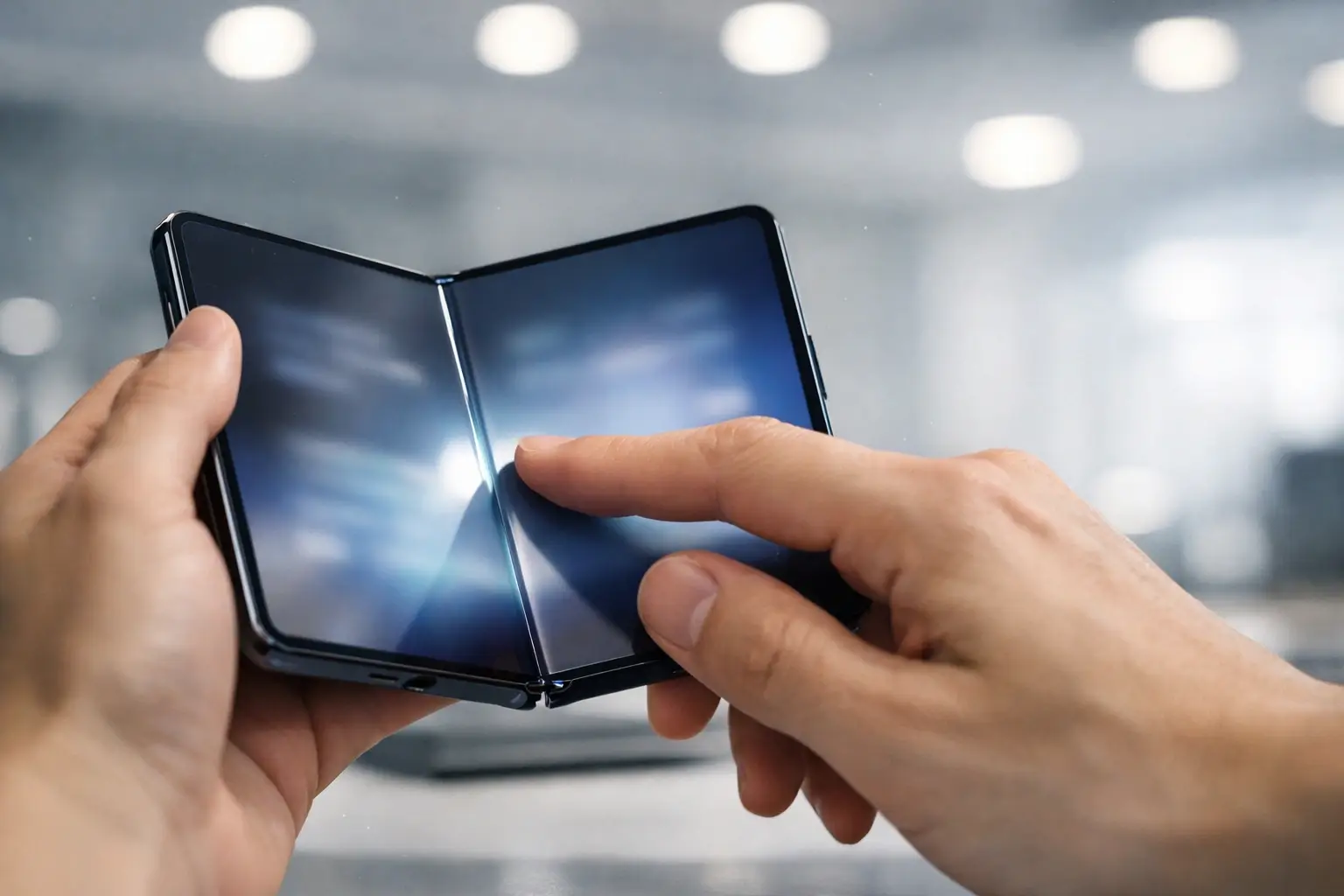
Crease-free display: what that likely means
Foldables bend. The bend line shows up.
That line is the “crease” everyone argues about.
A crease-less display claim usually means this: the fold line is harder to see in normal viewing. At CES 2026, a Samsung Display panel shown in the wild fed the “almost invisible crease” story, and some coverage says the goal is “invisible all the time.”
We should be careful with the phrase crease-free foldable. In the real world, even tiny changes in angle and lighting can reveal lines. So here’s the practical way to think about it: “less noticeable in more situations.”
Display tech terms people keep searching
You’ll see a lot of jargon in iPhone Fold rumors / leaks / everything we know pages. Here are the terms that matter.
OLED / foldable OLED
OLED is a display type where each pixel makes its own light. That helps with deep blacks and contrast.
Ultra-thin glass / flexible glass (UFG talk)
Foldables often use very thin glass plus layers that protect it. It can feel different from a normal phone screen.
Brightness, reflections, and polarizer talk
This is the part reviewers notice. Higher brightness helps outdoors. Reflections and glare make creases easier to spot. A screen layer setup can also change how sharp text looks in sunlight.
What to check in daily use
If you ever test a foldable in a shop, don’t just stare at a demo video.
Do this instead.
- Look at the fold area under bright ceiling lights
- Swipe across the fold line and note the feel
- Read small text on white backgrounds
- Tilt the screen and check for glare
Those checks tell you more than a spec sheet.
Hinge and durability: the make-or-break section
The hinge is the whole game.
A weak hinge ruins the phone.
Some reports talk about a higher-quality hinge, with materials described as liquid metal hinge, amorphous alloy, or metallic glass. The idea is simple: stronger hinge parts, smoother motion, and a flatter open position.
Where foldables often fail
Foldables don’t usually fail in one dramatic moment.
They fail in small, annoying ways.
- Dust or grit causes rough folding
- The fold area gets tiny dents over time
- The screen protector layer lifts at the edge
- The hinge gets a slight wobble
- Drops hit the corner and stress the hinge
That’s why “flat-open” and “minimal gap” talk matters. A small gap can invite dust. A hinge that opens flatter can reduce stress on the fold area.
How Apple could avoid early foldable failures
If the iPhone Fold exists to win trust, it needs boring reliability.
That means fewer surprises after month three.
Watch for signals like: easy service options, clear guidance on the screen layer, and a strong repair program. If those parts look vague at launch, that’s a reason to wait.
Specs we expect (and why they matter)
Specs aren’t just bragging rights.
They decide battery life, heat, and everyday smoothness.
Chipset
Several rumour roundups point to an A20 / A20 Pro expectation, with talk of TSMC 2nm manufacturing. The simple takeaway: better efficiency matters more on a foldable because it’s powering more screen area.
Battery
Foldables drain battery faster for one plain reason: bigger screens need more power.
That’s why battery rumours matter more here than on a normal phone.
One guide roundup talks about a battery in the 5,400–5,800 mAh range and mentions work on display efficiency to help battery life.
Modem + 5G
Connectivity problems feel like phone problems, even when they’re network problems.
So the modem matters.
A rumour roundup says a C2 modem could support mmWave and aim for parity with Qualcomm modems. That’s important for speed, but also for stable connections in busy areas.
eSIM-only / no SIM slot
An eSIM-only phone works well when your carrier supports it.
It’s painful when your carrier or travel plan doesn’t.
One report says the foldable may ship with no SIM slot, using eSIM instead. If you travel a lot, that’s a detail to watch early.
Cameras and biometrics
Foldables make camera design harder.
Space gets tight fast.
Touch ID vs Face ID
Some reporting suggests Touch ID side button could replace Face ID due to space limits inside a thin foldable. Another roundup also points to Touch ID built into a side button and links it to the device’s unfolded size being closer to a small tablet.
Under-display camera
A bigger inner screen tempts brands to hide the camera under the display.
It looks cleaner, but it can hurt selfie quality.
An earlier report roundup claims an under-display camera may show up on the inner display, but we’d treat that as “watch and wait” until real photos exist.

Pricing: is $2,400 believable, and who is it for?
$2,400 is serious money.
So we need a reality check.
A major rumour guide ties the $2,400 figure to Fubon Financial Holding (Fubon Research), while also listing a wider range from UBS and Barclays. That’s why headlines bounce between $1,800 and $2,500.
The buyer math vs “iPhone + iPad mini”
A foldable only makes sense if it replaces something.
Otherwise, it’s a third screen you didn’t need.
Here’s a simple way to think about the value at $2,399 / $2,400:
- If you already buy a top iPhone and a small tablet, a foldable could combine that habit
- If you only use one device and rarely multitask, you might pay for a feature you won’t use
- If you travel often, one device can be easier than two, but repairs can be a pain
The key question isn’t “Is it worth $2,400?”
It’s “Will it replace a second device for me?”
Who should wait vs who should buy day one
Wait if you hate repair drama.
Wait if you need a phone that survives rough days.
Buy early only if you love new form factors, you’ve got a backup device, and you’re fine with first-wave trade-offs. That’s not hype. That’s how early tech usually works.
Competitors: why Samsung is bracing for iPhone Fold
Competition shapes the whole foldable market.
It pushes designs toward what buyers actually want.
Multiple reports say Samsung is planning a wider “Wide Fold” with a 7.6-inch inner screen and 5.4-inch cover screen, and a production target around one million units. That’s framed as a direct response to the iPhone Fold and its wider, 4:3-like style.
We’ve seen this “wider foldable” idea before with Pixel Fold and OnePlus Open, and some reporting says that wider layout could be the shape the iPhone Fold follows.
If you’re comparing options today, the point isn’t brand loyalty.
It’s picking the shape that fits your life.
Rumor scorecard and what to watch next
Rumours aren’t all equal.
Some come from supply chain chatter. Some come from analyst notes. Some come from wishful thinking.
On this topic, reports often cite The Information for screen layout details, and ET News for supply-chain and production talk. We also see repeated references to Bloomberg reporter Mark Gurman and analyst Ming-Chi Kuo.
We rate rumours like this:
If multiple independent sources repeat it, confidence rises. If only one source says it, confidence stays low.
| Claim | Current best read | Confidence |
|---|---|---|
| Launch window | fall 2026, often September | High |
| Price band | $2,000–$2,500 | High |
| $2,399 / $2,400 anchor | specific research note claim | Medium |
| 4:3 iPad-style inner screen | widely repeated | Medium-High |
| Crease-less display | tied to CES 2026 panel talk | Medium |
| A20 on 2nm + C2 modem | detailed guide roundup | Medium |
| eSIM-only | reported in guide roundup | Medium |
Timeline checkpoints
Here’s what usually happens before a launch like this:
- Spring: more parts talk and early accessory leaks
- Summer: clearer production chatter and more consistent size claims
- Early September: event invites and final leaks
If the iPhone Fold is real for 2026, the summer period is where details should tighten.
Update log
- 31 Jan 2026: refreshed launch window, screen size ranges, and pricing band using the latest roundups.
- 30 Jan 2026: added supply-chain context on premium model timing.
One last trust check
Rumour pages can feel like noise.
We get it.
If you take one thing from this guide, take this: treat the iPhone Fold like a high-cost tool, not a status item. Ask what it replaces, how you’ll protect it, and what you’ll do if it needs repair.
Also keep an eye on the glass story. Foldables live or die by screen layers, and one long-running rumour thread even mentions Corning in the foldable glass context.
If you want, send me your current phone and how you use it day to day. We’ll work out whether a $2,400 foldable actually fits your life, without hype.
FAQs
How much will the iPhone Fold cost?
Most reports put the iPhone Fold price in a $2,000–$2,500 band, with $2,399 or $2,400 often quoted as a specific estimate. We should treat that figure as a reported target, not a promise. Final pricing can change with parts costs, storage tiers, and launch regions.
That range shows up in multiple rumour roundups and a dedicated rumour guide.
When is the iPhone Fold coming out?
The iPhone Fold release date most often points to fall 2026, with many articles naming September 2026 as the likely launch window. A separate supply-chain report also talks about a premium-focused launch in the second half of 2026. None of this is confirmed until an event invite lands.
This timing appears across recent rumour coverage.
Will the iPhone Fold really be crease-free?
“Crease-free” usually means the fold line is much harder to see in normal viewing, not that physics stops applying. Coverage tied to CES 2026 suggests a crease-less panel exists, but real proof comes from hands-on testing under harsh light. Expect “less visible,” not “never visible.”
CES 2026 panel coverage drives most of this claim.
What size will the screens be when folded and unfolded?
One common rumour set says a 5.3–5.4-inch cover display and a 7.6–7.7-inch inner display, aiming for a 4:3 iPad-style shape. Another set mentions 5.5 inches outside and 7.8 inches inside. We won’t know the final screen size until the supply chain stops disagreeing.
These ranges show up in recent roundups.
Is it a book-style foldable or a flip phone?
Most iPhone Fold rumours point to a book-style foldable that opens like a book, not a flip that folds top to bottom. That matches the repeated focus on a wider inner screen and an iPad-style feel when open. A flip design would trade that big inner screen for a smaller footprint.
Both the design framing and screen talk lean book-style.
Will it have Face ID or Touch ID?
Several reports say Face ID could be hard to fit in a thin foldable, so the company may use Touch ID in a side button instead. That choice would save internal space and keeps unlock simple with a thumb press. It’s still a rumour, but it’s consistent across sources.
Touch ID talk appears in multiple roundups.
Will the iPhone Fold be eSIM-only?
One major rumour guide says the iPhone Fold may drop the physical SIM tray and use eSIM only. That’s fine for many carriers, but it can complicate travel or switching providers in some regions. If you rely on physical SIMs, this detail is worth checking before launch day.
The “no SIM slot” claim appears in a dedicated rumour roundup.
What chip will it use?
A detailed rumour guide says the foldable could use an A20-class chip built on a 2nm process. The important part isn’t the label. It’s efficiency, because foldables push more pixels and need better battery control. A cooler chip also helps performance stay steady during long tasks.
Chip and process talk comes from the same rumour roundup.
How durable are foldables and what usually fails first?
Foldables can last, but their weak spots are well known: hinge wear, dust getting into moving parts, and the fold area taking repeated stress. Many issues start small, like a rough fold or lifted screen layer, then grow over time. A strong hinge and good service options matter more than brag specs.
Hinge quality and “flat-open” talk show why durability keeps coming up.
Should I buy a foldable now or wait for Apple?
Buy now if you want the form factor today and you’re happy with current foldable trade-offs. Wait if you want iOS, a wider 4:3-style inner screen, and you’d rather see real durability tests first. With $2,000–$2,500 pricing talk, waiting also helps you avoid guesswork.
The timing and pricing uncertainty are real, not drama.








[…] up AI workflows with no tech team is entirely possible now that we have drag-and-drop interfaces that require no coding skills […]
[…] Go to Settings, then Passwords, and you’ll find the Family Passwords card there. On iOS 18, Apple moved everything into a dedicated Passwords app. It’s a standalone app with its own icon, cleaner navigation, […]
[…] I wait for Apple?” question isn’t silly anymore. A Reuters report on January 30, 2026 says Apple plans to launch a foldable iPhone in 2026, with a clamshell model also expected in […]