




Zero-Step Entries & Universal Design: Make Your Home Accessible for All Ages
Home advice can feel like noise. One person says “just add a ramp,” another says “you’ll fail building regs,” and a third tries to sell you a gadget you don’t need.
Table Of Content
- What Universal Design Means in a Home
- Universal design vs accessibility vs visitability
- Where the idea came from
- The 7 principles and what they look like at home
- Why a Zero-Step Entry Is the #1 Upgrade to Start With
- The “visitable home” baseline
- Zero-Step Entry Design: New Build vs Updating an Older Home
- Pick the right entrance
- Build a step-free approach route
- Slopes and ramps in plain English
- Surfaces, drainage, and slip resistance
- Get the doorway right
- Threshold-free vs low threshold
- Quick measurement checklist
- How to Plan a Zero-Step Entry in 5 Steps
- Universal Design Inside the Home: Room-by-Room Wins
- Hallways and circulation
- Bathroom: the make-or-break room
- Kitchen
- Bedroom and laundry
- Costs, Value, and the “Do It Once” Strategy
- Budget tiers that make sense
- Hiring Help and Avoiding Costly Mistakes
- What to ask a contractor
- Permits and local checks in the UK
- Getting specialist input
- Next Steps We’d Do This Week
- FAQs
- What is universal design in housing?
- Is universal design the same as accessibility?
- What is a zero-step entry, and why does it matter?
- What’s the difference between universal design and visitability?
- How wide should a doorway be for accessibility?
- What’s the maximum threshold height for an accessible doorway?
- What slope is considered an accessible walkway vs a ramp?
- Is universal design expensive?
- What are the easiest universal design upgrades to do first?
- Can an older home be made step-free without a big ramp?
We get why you’re cautious. A wrong choice can mean slips at the door, water getting inside, or money spent twice.
So we’ll keep this plain and practical. Universal design means homes that are usable by all people, to the greatest extent possible, without adaptation or specialised design, and that mindset works brilliantly for real UK houses.
What Universal Design Means in a Home
Universal design (UD) isn’t “medical” design. It’s everyday design that works for more people, more of the time.
Think of it like good lighting. It helps a child find the loo at night, and it helps a grandparent too.
The Centre for Excellence in Universal Design links UD to products, environments, programmes, and services that people can use widely, without needing special changes just to get in the door.
Universal design vs accessibility vs visitability
Accessibility often targets a specific need. It’s vital, but it can end up as “added on later.”
Universal design aims wider. It builds in choice, space, and easy use from the start, so you don’t need to add fixes after.
Visitability sits at the simple end. It’s a basic housing baseline that focuses on one step-free entrance, easier doors, and a usable ground floor toilet.
Where the idea came from
Universal design grew from work in barrier-free design, pushed forward by architect Ronald Mace in the 1980s.
It also shows up in rights language. The United Nations Convention on the Rights of Persons with Disabilities backs universal design as a preferred approach, and that definition gets quoted often because it’s clear.
In the UK and Ireland, people sometimes link UD to policy language too, like the Disability Act 2005 context used in Irish UD guidance.
The 7 principles and what they look like at home
The classic 7 principles help us check if a design suits real people, not just “ideal” users.
- Equitable Use: One entrance that works for everyone, not a “special door” round the back.
- Flexibility in Use: A door that opens with a lever handle or a pull, even if your hands are full.
- Simple and Intuitive: Light switches where you expect them, with clear labels and no weird controls.
- Perceptible Information: Good contrast and legibility, like a darker stair edge or a clear door frame colour.
- Tolerance for Error: Fewer trip hazards, safer lighting, and surfaces that stay grippy when wet.
- Low Physical Effort: Doors that don’t need a hard pull, taps you can turn easily, drawers that glide.
- Size and Space for Approach and Use: Enough room to turn, park a buggy, or use a walker without banging into furniture.
Keep those in mind as we talk about the big win: the front door.
Why a Zero-Step Entry Is the #1 Upgrade to Start With
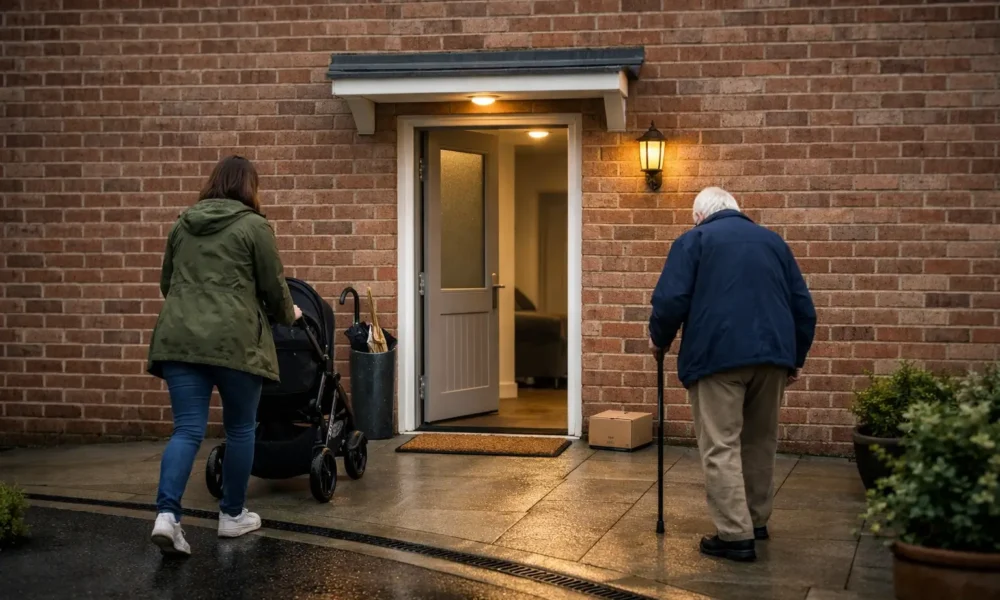
A zero-step entry changes daily life fast. It helps with buggies, suitcases, deliveries, wheelchairs, and the “I’ve twisted my ankle” weeks.
It also cuts one of the most common fall triggers: the little step you stop noticing until you catch your toe.
Most homes can get one step-free entrance. It doesn’t have to be the “main” door, as long as it’s the door you use.
The “visitable home” baseline
Visitability is a smart bridge idea. It’s not full accessibility, but it removes the biggest barriers for guests and many residents.
The National Council on Independent Living (NCIL) sums it up as three basics: one zero-step entrance, doors with 32 inches of clear passage space, and one bathroom on the main floor you can get into in a wheelchair.
We like this because it’s measurable. You can stand in your doorway with a tape measure and know where you are.
Zero-Step Entry Design: New Build vs Updating an Older Home
New builds can plan the level route from day one. That usually costs less than changing levels after the fact, because the groundworks and thresholds get set once.
Older homes can still work well. The trick is to pick the easiest entrance and design the approach route like a mini outdoor system, not a random patch of paving.
Either way, the same things matter: slope, drainage, grip, lighting, and door details.
Pick the right entrance
Start with how you live. Where do you park, where do deliveries land, and which door feels safest in rain.
For many UK homes, the best step-free entrance is the side door or garage-to-kitchen door. It often sits closer to driveway level.
Front doors can work too, but they can be harder on sloped sites or houses with high thresholds.
Build a step-free approach route
This is the bit people skip. Then they wonder why the “no-step” entrance still feels awkward.
A step-free route needs enough width, gentle slope, and a surface that stays firm and even.
UK guidance summaries often point to a clear route width around 900 mm (sometimes 750 mm where there are pinch points), with gentle gradients where possible.
Slopes and ramps in plain English
A gentle slope feels like “walking normally.” A ramp feels like “I’m leaning forward.”
ADA guidance gives a clear rule of thumb: walking surfaces on an accessible route shouldn’t be steeper than 1:20, and if you go steeper, treat it like a ramp.
For ramps, ADA sets a common maximum running slope of 1:12.
UK building guidance also uses similar bands, often treating 1:20 as the line between gentle slopes and ramped routes, with step-free routes avoiding big upstands.
If you remember one thing, remember this: short and steep beats you up, but long and gentle gets used.
Surfaces, drainage, and slip resistance
Flush thresholds sound perfect. Then the first storm arrives.
If water sits at the door, it can track in, swell timber, rot frames, and leave you with mould or slipping risks.
That’s why “water management” matters. Plan a fall for drainage, use a firm, even surface, and avoid loose gravel where wheels and canes sink. UK supporting guidance calls out surfaces that are reasonably firm, even, and slip resistant.
Get the doorway right
The door is the pinch point. If the route is smooth but the door is tight, you still struggle.
A common benchmark for door openings on accessible routes is 32 inches (815 mm) minimum clear width in ADA standards.
“Clear width” means the space you get when the door is open, measured between the door face and the stop. It’s not the door leaf size.
Threshold-free vs low threshold
Here’s the honest trade-off. The more flush the threshold, the more your drainage and weather sealing need to be right.
ADA limits thresholds to 1/2 inch (13 mm) maximum for new work on compliant doorways.
UK dwelling guidance often talks about an “accessible threshold” with a small upstand, commonly no more than 15 mm in typical guidance summaries tied to Approved Document M.
In plain terms: flush is great, but only if you also plan for rain, splashback, and runoff.
Quick measurement checklist
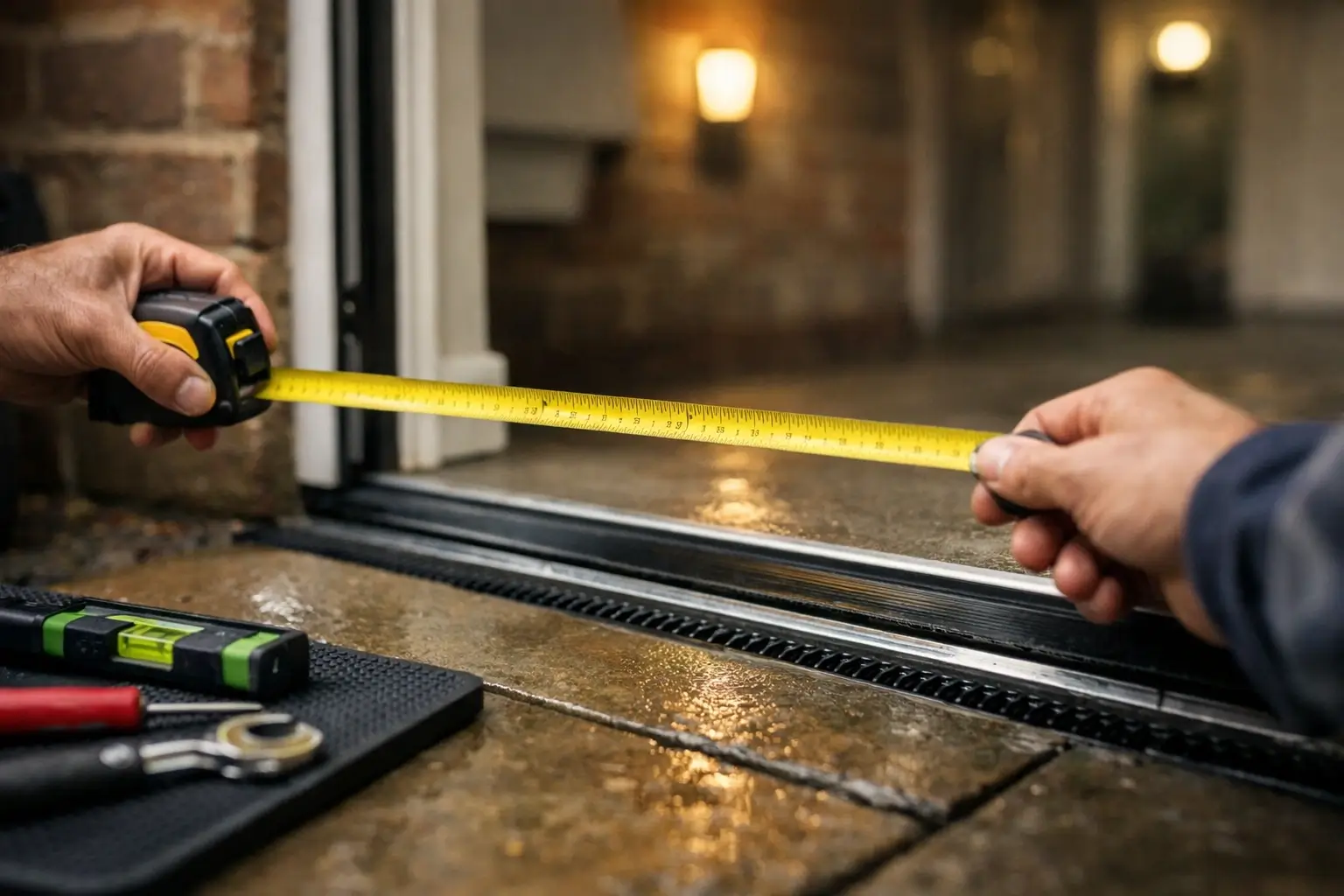
Use this before you call a builder. It saves awkward “we thought it would fit” moments.
- Measure the clear opening of the door, not the frame. Aim for 32 inches (815 mm) minimum as a useful benchmark.
- Check the threshold height. ADA guidance sets 1/2 inch (13 mm) max for new work.
- Check the route slope. ADA sets 1:20 max for walking surfaces on an accessible route.
- If it’s a ramp, use 1:12 max as a common guide.
- Walk the route at night. If you can’t see edges, add lighting before winter.
How to Plan a Zero-Step Entry in 5 Steps
This is the “no panic” plan. You can do it in stages.
- Choose the door you’ll use. Pick the entrance closest to parking and daily life.
- Map the route. Note slopes, tight turns, and any steps or upstands.
- Fix water first. Plan drainage and surface grip before you worry about fancy finishes.
- Sort the threshold and door. Aim for a low threshold, good seals, and enough clear width.
- Add safety details. Lighting, a covered porch, and a place to pause and set bags down.
Universal Design Inside the Home: Room-by-Room Wins
Once you get in easily, the rest of the house should feel calm to move through.
This is where universal home design shines. Small changes can remove daily friction, even if nobody in your home has a disability.
We’re talking walkers, canes, buggies, a knee brace, or just carrying a laundry basket.
Hallways and circulation
Wide hallways sound like a “nice extra” until you try to pass someone while holding a box.
Visitability guidance often points to wider ground-floor circulation, like hallways around 36 inches clear in some frameworks.
In UK homes, you may not widen every corridor. You can still clear pinch points by moving furniture, changing door swings, or using sliding doors where suitable.
Also watch floors. Loose rugs, curled mats, and uneven thresholds are classic trip hazards.
Bathroom: the make-or-break room
A ground-floor bathroom you can enter is one of the visitability basics.
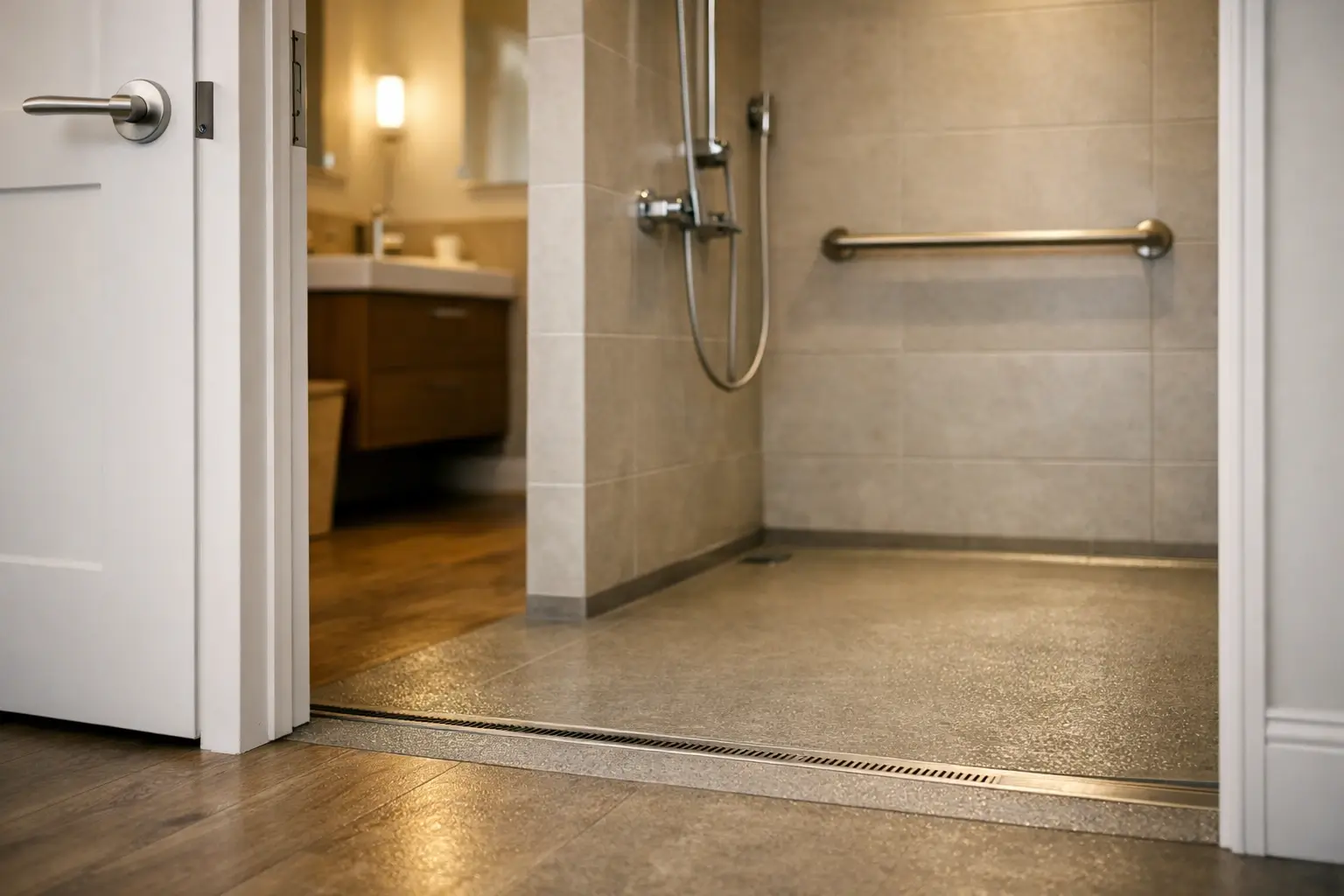
That doesn’t mean a full wet room on day one. It can mean making sure the door isn’t too tight, the floor isn’t slippery, and there’s space to turn.
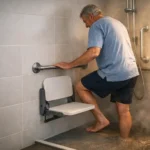
Plan ahead for grab bars even if you don’t want them yet. Ask for solid wall backing now, so you don’t have to rip tiles later.
If you’re changing the shower, a curbless shower or zero-threshold shower can remove a big fall risk, but only if the fall to the drain is right and the floor stays grippy.
Kitchen
A universal kitchen isn’t a special kitchen. It’s a kitchen that doesn’t punish you for being tired.
Look for low physical effort features. Think pull-out shelves, D-handles, and drawers that slide well.
Add task lighting under cabinets. It cuts glare and makes contrast and legibility better when you’re chopping or reading labels.
If someone uses a stool or wheelchair, knee space under one prep spot helps, and it doesn’t ruin the look.
Bedroom and laundry
Main-floor living matters when stairs start to bite. A “forever home” plan often includes the option of a main-floor bedroom, even if it’s a study today.
Laundry is similar. If you can keep a washer on the same level as bedrooms, you reduce heavy trips.
Reachable controls also help. Think sockets, switches, and thermostats that don’t force you into awkward stretches.
Costs, Value, and the “Do It Once” Strategy
Costs swing a lot. A flat plot with simple paving is a different world from a steep garden with drains and retaining edges.
Still, there’s a clear pattern. Early planning costs less than late fixes, because ground levels, thresholds, and door openings tie into structure and water control.
WBDG notes that including visitability and access features at design stage is usually easier than later changes.
Budget tiers that make sense
Low cost wins: Lighting, lever handles, grip strips, replacing curled mats, and changing a high threshold where possible.
Medium work: Adjusting ground levels, widening a doorway, rebuilding a small landing, or adding a short ramp with rails where needed.
Structural work: Larger groundworks, major level changes, moving bathrooms, or major door relocation.
The smart move is to spend first where mistakes hurt most: the entry route, the threshold, and the bathroom access.
Hiring Help and Avoiding Costly Mistakes
This topic attracts half-truths. A builder might be great at kitchens but shaky on access routes and drainage details.
If you hire, ask questions that force real answers.
What to ask a contractor
Ask these before you accept a quote:
- “How will water drain away from the door?”
- “What threshold height are you targeting?”
- “What slope will the route be, and how long is it?”
- “How wide is the clear door opening once hardware is in?”
- “What surface finish stays slip resistant when wet?”
If they can’t explain it simply, that’s a risk.
Permits and local checks in the UK
Some changes need Building Control sign-off. It can depend on what you change, where you change it, and whether you touch structure, drainage, or door openings.
In England, Approved Document M gives guidance on access and use of buildings, and it has a volume for dwellings (new homes and some major alterations).
A good local first step is a chat with your council Building Control or a Local Authority Building Control team about what counts as a “material alteration.”
Getting specialist input
Sometimes you want a second brain. An occupational therapist can flag daily-use issues you won’t spot from drawings.
On the builder side, the Certified Aging-in-Place Specialist (CAPS) credential is one recognised route tied to aging-in-place remodeling and universal design concepts.
It’s not a guarantee, but it’s a useful filter when you feel overwhelmed by who to trust.
Next Steps We’d Do This Week
Pick one entrance to make step-free. Then measure the route, the door clear width, and the threshold.
Sketch the water plan before you pick finishes. If you can’t explain where the water goes, don’t build yet.
Finally, treat visitability as your minimum target. One zero-step entrance, easier doors, and a usable ground-floor bathroom can change how your whole home feels.
FAQs
What is universal design in housing?
Universal design in housing means planning spaces so they’re usable by all people, as much as possible, without needing special changes later. In practice, that means easier entry, clear routes, simple controls, safe surfaces, and enough space to move. It helps across ages, injuries, and abilities.
Universal design isn’t just for wheelchairs. It covers strollers, walkers, deliveries, and tired days too.
It also links to dignity and independence, because people can use the same spaces without workarounds.
Is universal design the same as accessibility?
No. Accessibility often aims at meeting specific access needs or rules. Universal design aims wider, so more people can use the home in more situations without special add-ons. They overlap a lot, but universal design focuses on everyday usability for a broad range of ages and abilities.
A home can be technically accessible in one area but still annoying to live in. UD pushes for fewer “gotcha” moments.
That’s why simple things like lighting, handles, and space matter.
What is a zero-step entry, and why does it matter?
A zero-step entry is a step-free entrance along an accessible path of travel, so you can get in without climbing a step. It matters because steps and high thresholds cause trips and block wheels. One step-free door also makes deliveries, buggies, and injury recovery much easier.
It’s the fastest way to make a home feel friendlier.
And you only need one to start.
What’s the difference between universal design and visitability?
Visitability is a basic access baseline for homes, focused on three features: one zero-step entrance, doors with 32 inches of clear passage space, and a ground-floor bathroom a wheelchair user can enter. Universal design goes further, covering the whole home experience, not just entry-level access.
Visitability is a great first target because it’s clear and measurable.
Universal design is the wider set of choices that makes the home easier long term.
How wide should a doorway be for accessibility?
A common benchmark is 32 inches (815 mm) of clear width at the doorway. “Clear width” means the usable opening when the door is open, measured between the door face and the stop. This number appears in the ADA 2010 Standards and is often used as a practical check point.
In older UK homes, you might not hit this everywhere. But you can often fix key doors, like the step-free entrance and the ground-floor bathroom.
Always measure the clear opening, not the door slab size.
What’s the maximum threshold height for an accessible doorway?
ADA guidance limits thresholds to 1/2 inch (13 mm) maximum in new work on compliant doorways, because small upstands trip people and stop wheels. UK guidance summaries linked to Approved Document M often use a low threshold approach too, with accessible thresholds typically kept very low to support step-free routes.
Lower is usually better, but water control matters.
If you go very low, plan drainage and sealing with care.
What slope is considered an accessible walkway vs a ramp?
ADA guidance draws a clear line: walking surfaces on an accessible route shouldn’t be steeper than 1:20, and if they are, treat them as a ramp. For ramps, ADA sets a common maximum running slope of 1:12. UK guidance uses similar bands in many summaries of dwelling access routes.
On real sites, the goal is “long and gentle.” That’s usually safer and more likely to be used.
Short, steep routes get ignored, even by people who could technically use them.
Is universal design expensive?
It depends on timing. If you plan universal design during a new build or a major renovation, many features cost little, because they’re baked into layout, levels, and door choices. Costs rise when you change ground levels, structure, or drainage later. A staged plan often keeps it manageable.
Start with low cost friction points first.
Then do the bigger structural pieces only if the home needs them.
What are the easiest universal design upgrades to do first?
Start with changes that cut trips and reduce effort: better lighting, non-slip surfaces, removing curled mats, lever handles, and a safer low threshold at one entrance if possible. Next, focus on the ground-floor bathroom door and route. These steps match visitability basics and improve daily use fast.
These upgrades also help resale because they feel like quality, not medical kit.
They also lower the chance of costly “redo” work later.
Can an older home be made step-free without a big ramp?
Often, yes. Many older homes can use a side or rear door where levels are closer to the drive or garden. Small ground regrading, a longer gently sloped path, or reworking a landing can remove steps without a long ramp. The key is slope, drainage, and a low threshold at the door.
The best answer comes from a site check with a tape measure and a look at where rainwater goes.
If the only option is a ramp, keep it gentle and safe.




[…] lot of UK homes don’t meet basic access needs. Centre for Ageing Better has highlighted how rare truly accessible homes […]
[…] NCSC paper describes a cybercrime ecosystem with access brokers selling entry and affiliates running […]
[…] closing, plus a starter repair fund for the home. The exact number depends on job stability and the home’s age, but “zero left” is a risky place to […]
[…] accessible entry makes daily life easier for walkers, canes, and wheelchairs. It also helps when carrying shopping […]
[…] Utility companies often run free or subsidised programmes. And an audit is often required to access HOMES or HEAR rebate funding through the Inflation Reduction […]